

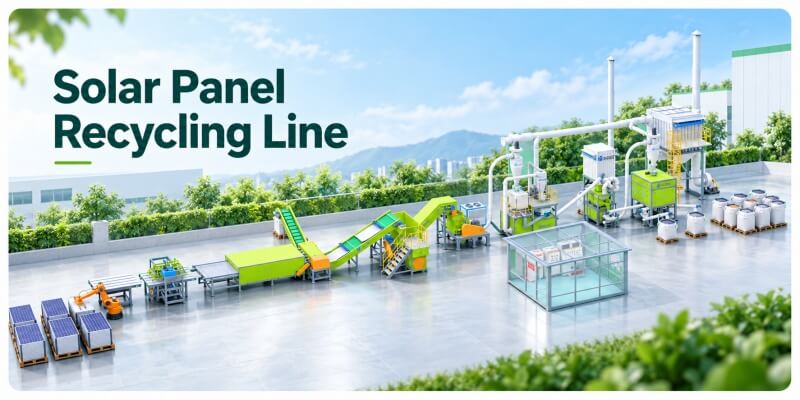











Establishing a profitable solar panel recycling facility demands precise financial planning. High-capacity recyclers, Appaltatori EPC, and waste management investors require high-purity material yields alongside strict environmental compliance. Equipment purchase prices represent only initial setup expenses; true long-term profitability depends heavily on daily operational efficiency, silver extraction rates, and advanced flue gas purification systems. If you have any requirements, we also can provide you with a customization design for your solar panel recycling plant.
How to Plan Initial CAPEX for High-Throughput Solar Panel Recycling Lines?
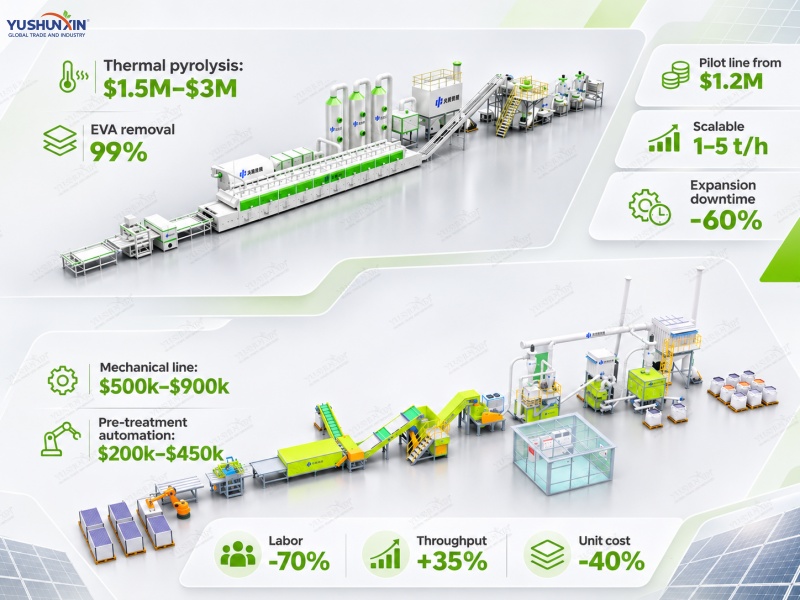
Initial capital expenditure determines long-term plant viability. Investors must look beyond equipment cost to evaluate structural automation, line scalability, and footprint efficiency. Balancing continuous thermal pyrolysis against mechanical processing creates a predictable financial foundation for industrial-scale commercial profitability.
Continuous Thermal Pyrolysis vs Mechanical Processing Cost
Continuous thermal pyrolysis requires an initial machinery investment of $1.5M to $3M for a standard line, compared to $500k to $900k for basic mechanical shredding systems. Tuttavia, automated continuous thermal lines reduce long-term unit processing costs by 40% and achieve 99% EVA removal efficiency, significantly boosting downstream material purity.
Pre-treatment Automation Infrastructure Budget
Scalable Line Design for 1-5 t/h Capacity
Why Does Panel Type Impact Long-Term OPEX of PV Recycling Plant?
Photovoltaic module architecture directly impacts thermal residence time and energy consumption. Single-glass and double-glass panels require distinct furnace parameters, impacting utility costs. Adapting thermal degradation profiles to panel variations maintains operational efficiency and controls monthly utility expenses.
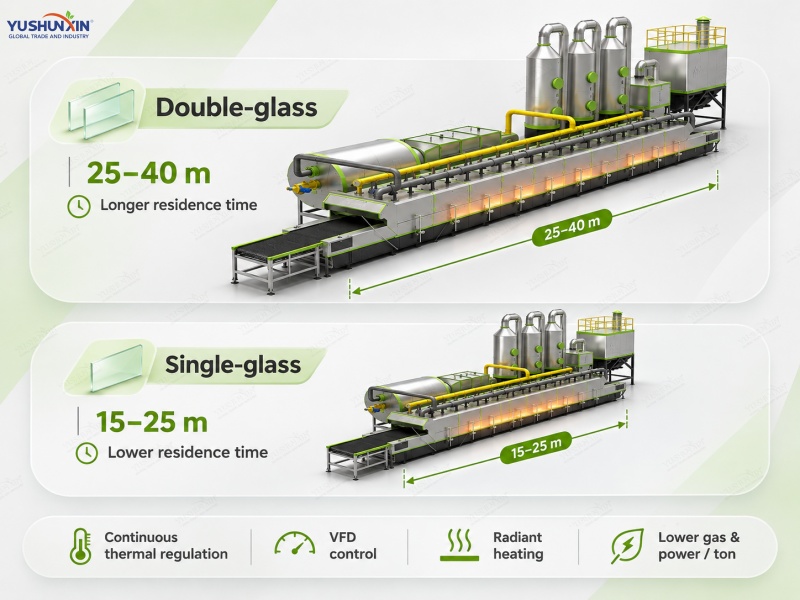
Tunnel Furnace Thermal
Energy Consumption Comparison
Double-glass panels demand longer furnace residence time, requiring extended 25-40m tunnel furnaces compared to 15-25m setups for single-glass. Heated zones must maintain continuous thermal regulation. Variable frequency drives and targeted radiant heating minimize overall gas and electricity consumption per ton.
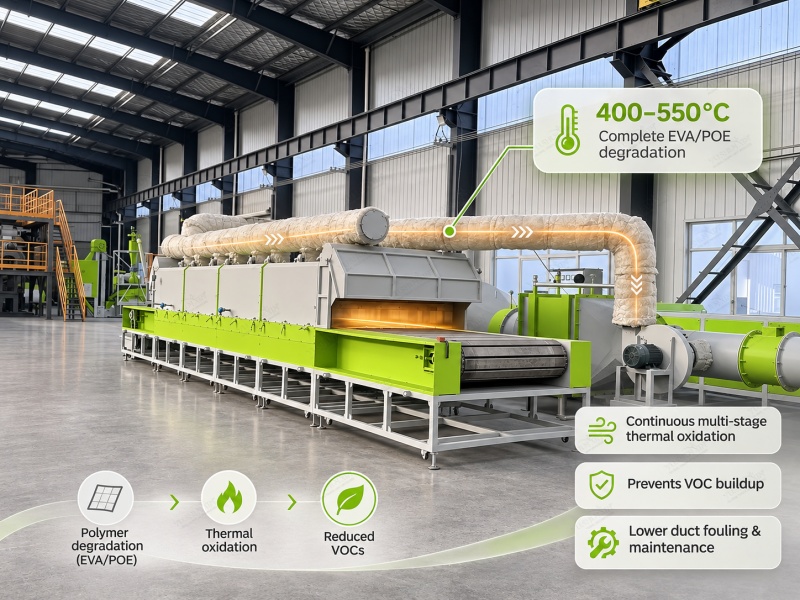
EVA/POE Thermal Degradation
& Gas Emissions Budget
Complete EVA/POE polymer decomposition occurs between 400°C and 550°C. Incomplete degradation creates viscous residue that fouls exhaust ducts. Budgeting for continuous multi-stage thermal oxidation prevents toxic volatile organic compound (VOC) buildup, maintaining system efficiency and lowering maintenance overhead.
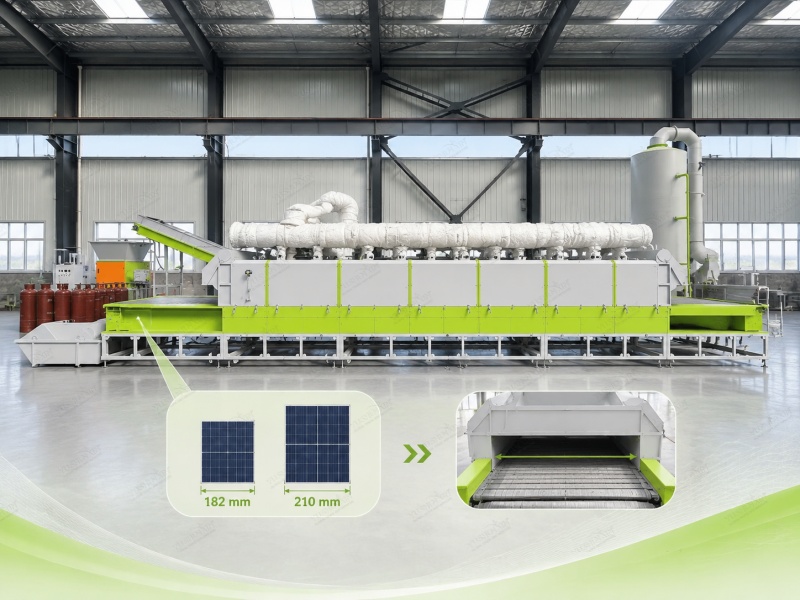
Adaptability Costs for
Large-Format Panels
Processing modern 182mm and 210mm ultra-large modules requires wider intake thermal chambers and reinforced conveyor systems. Retrofitting narrow lines causes bottlenecking. Investing in wide-chamber furnace architecture upfront prevents costly structural modifications when processing next-generation commercial waste.
How to Maximize Revenue via Silver Extraction of Solar Panel Recycling Machine?
Silver constitutes under 0.1% of panel weight but accounts for over 50% of total output value. Integrating wet hydrometallurgy into the recycling line transforms low-margin glass and alluminio operations into high-yield refineries, drastically shortening the investment payback period and boosting plant profitability.
CAPEX for Chemical Leaching and Refining Lines
Hydrometallurgical silver recovery requires specialized acid-resistant PPH/FRP reactor tanks, filtration units, and electrolytic refining cells, with setup costs ranging from $400k to $800k. Recovering roughly 500g to 800g of silver per ton of panels creates $400 A $650 in silver revenue per ton, making silver responsible for over 50% of total plant gross profits.
Reagent Costs and Recovery Thresholds
Acid leaching relies on optimized nitric acid and neutralizing agent dosing, averaging $80 A $120 in reagent costs per ton of input material. Implementing closed-loop acid recovery systems recycles up to 85% of spent nitric acid, reducing chemical procurement expenses by 30% while maintaining a consistent 98%+ silver extraction threshold.
High-Purity Electrolytic Silver Revenue Projection
Refining recovered silver to ≥ 99.99% purity grade allows facilities to command full spot market prices ($0.80-$1.00/g) without third-party smelter discount penalties. Elaborazione 10,000 tons of PV waste annually generates $4M to $6.5M in high-purity silver revenue alone, significantly boosting gross profit margins and accelerating full plant CAPEX amortization within 2 years.
What Are Environmental Compliance Expenses in Solar Panel Recycling?
Industrial recycling facilities operate under strict regional environmental standards. Neglecting off-gas treatment and wastewater neutralization risks regulatory fines or facility closure. Allocating budget to closed-loop environmental control systems ensures continuous legal compliance, lowers risk, and supports long-term sustainable operations.
Thermal Pyrolysis Flue Gas Purification Systems
Pyrolysis flue gas treatment requires thermal oxidizers, rapid quench towers, and dual-stage acid mist scrubbers, costing between $250k and $500k. Removing halogenated compounds and particulate matter satisfies EPA and EU emissions standards, preventing heavy environmental fines and unscheduled plant shutdowns.
Wastewater Neutralization and Closed-Loop ZLD Budget
Hydrometallurgical silver leaching produces acidic wastewater requiring automated pH neutralization and Zero Liquid Discharge (ZLD) evaporator skids. Achieving 95% water reuse eliminates expensive off-site hazardous liquid transport costs and meets municipal water discharge compliance codes.
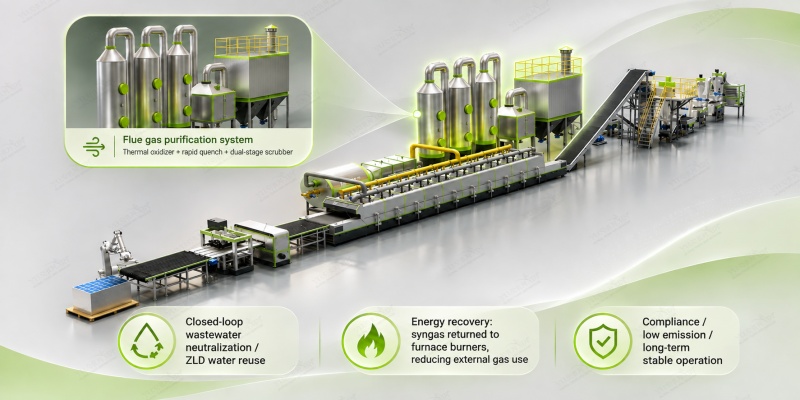
Self-Sustaining Energy Recovery Systems
Thermal decomposition of EVA/POE releases combustible hydrocarbon syngas. Capturing and redirecting these gases back to thermal pyrolysis furnace burners reduces external natural gas consumption by 30% A 50%, saving $40k-$90k annually in utility expenses while lowering net carbon emissions.
Ottieni la tua soluzione!What Is the ROI and Turnkey Price Spectrum for Solar Panel Recycling?
Turnkey solar panel recycling plant cost varies by capacity, livello di automazione, and refining depth. A clear financial model outlining capital cost, operational expenditure, material yields, and net revenue allows investors to build accurate feasibility studies and secure project financing.
Turnkey Plant Cost Tier Analysis
Turnkey pilot lines (1,000 TPY) cost between $800k and $1.5M, ideal for regional collectors. Large automated industrial facilities (10,000 TPY) range from $4M to $8M, delivering superior economies of scale and significantly lower per-ton operational processing expenses.
Revenue Yield and Daily OPEX Breakdown
Based on a 5 TPD processing line, monofacial panel output yields roughly $1,103/ton in recovered aluminum, rame, silicio, and silver. Factoring in panel purchasing, lavoro, and electricity costs ($3,537/day), facilities achieve strong daily net operating profit margins.
Capacity-Based Financial Modeling and ROI Calculation
A 10 TPD input capacity, annual net profit reaches $1.3M for monofacial panels and $925k for bifacial panels. Scaling capacity to 20 TPD increases annual net profit to $2.72M for monofacial modules, enabling full plant CAPEX amortization within 1 A 1.5 years.
Establishing a profitable commercial facility requires balancing initial turnkey setup costs against long-term operational efficiency. Integrating automated pre-treatment, continuous thermal pyrolysis, and hydrometallurgical silver extraction secures high material purity and maximum ROI. Ready to build a high-yield recycling facility? Explore our solar panel recycling equipment selection, learn about hydrometallurgical silver recovery technology, or read our technical report on pyrolysis furnace design for PV modules to request a customized turnkey quotation today.
"
Dalle tue esigenze
all'impatto reale


