


















Solar panel recycling plant cost is not a single machine price. It changes with panel type, recovery route, output quality, capacity, and delivery scope. A reliable budget should also include utilities, environmental systems, installation, and downstream processing. This article shows industrial buyers how to structure CAPEX, estimate operating costs, and compare investment options before requesting a final proposal.
Why Does Feedstock Affect to Set the Initial PV Recycling Plant Budget?
Feedstock data should establish the first budget boundary. Daily tonnage alone cannot define the required process. Buyers must confirm panel structure, condition, dimensions, contamination, and supply stability. These variables change equipment quantity, heat demand, dust control, and final product quality.
Match Each Module Type With the Correct Process
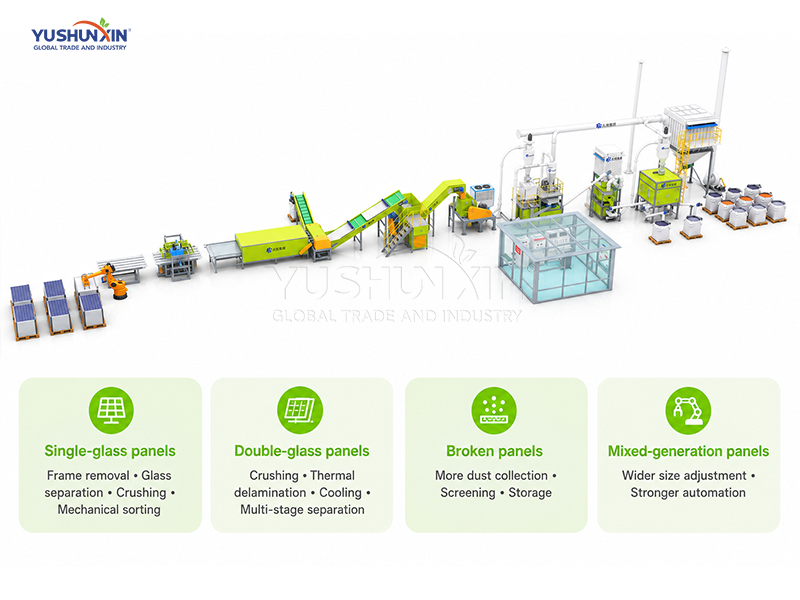
Single-glass panels may use frame removal, glass separation, crushing, and mechanical sorting. Double-glass panels often need crushing, thermal delamination, cooling, and multi-stage separation. Broken panels increase dust collection, screening, and storage requirements. Mixed-generation panels need wider size adjustment and stronger automation.
| Feedstock profile | Main budget effect |
| Single-glass modules | More mechanical separation options |
| Double-glass modules | Greater thermal and gas-treatment demand |
| Broken modules | More dust control and screening |
| Production scrap | Less pretreatment for stable material |
| Mixed-generation panels | More adjustment and automation |
| Wet or dirty panels | Added cleaning and drying systems |
Convert Annual Supply Into Design Capacity
Buyers should calculate capacity from secured annual supply. Required hourly capacity = Annual feedstock ÷ Operating days ÷ Operating hours ÷ Utilization rate. This formula allows time for maintenance, cleaning, material changes, and supply interruptions. Therefore, it reduces unnecessary oversizing.
Batch projects should also convert weight into panel numbers
Panels per batch = Rated batch weight ÷ Average panel weight. A single-glass panel may weigh about 20 kg. A double-glass panel may weigh about 32 kg. Therefore, a 16-ton batch holds about 800 single-glass panels. The same batch holds about 500 double-glass panels.
Reserve Budget for Feedstock Variation
Older panels may use different backsheets, EVA, or POE materials. Some suppliers may remove frames and junction boxes before delivery. Others may deliver sand, moisture, broken glass, or mixed metals. Therefore, Yushunxin bases the first budget on representative samples and agreed feedstock data.
How Should the Budget Change With Each Recovery Route?
Similar plant capacities can require different investments. Product targets, panel structure, and refining depth create cost differences. Therefore, buyers should choose the recovery route before comparing quotations.
Mechanical Recovery
Controls the Entry Budget
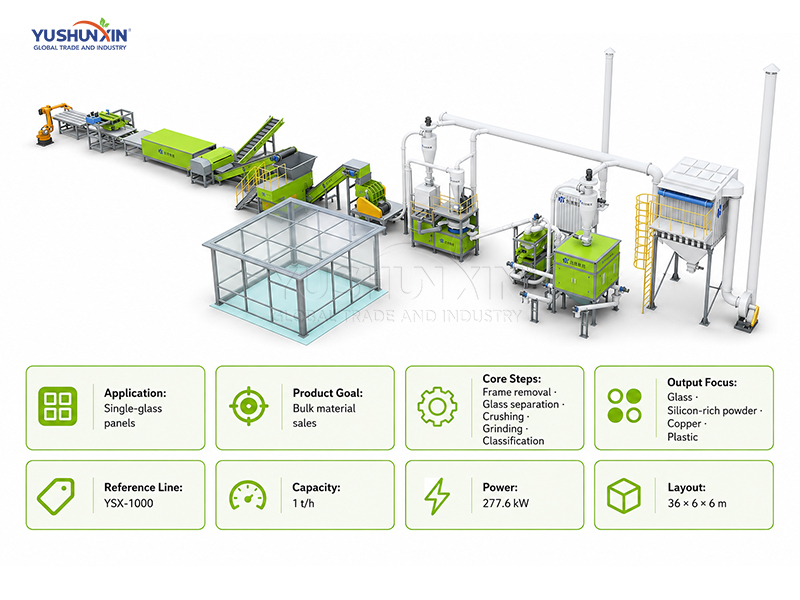
Mechanical PV recovery suits single-glass panels and bulk material sales. The line can remove frames, separate glass, crush laminates, grind residues, and classify fractions. However, each product target changes the equipment scope. Intact glass needs gentler handling and de-glassing. Silicon-rich powder needs finer grinding and tighter separation. Copper and plastic recovery add sorting stages and dust control. The YSX-1000 reference line processes 1 t/h. It uses 277.6 kW and needs 36 × 6 × 6 meters.
Thermal Delamination
Expands the Process Budget
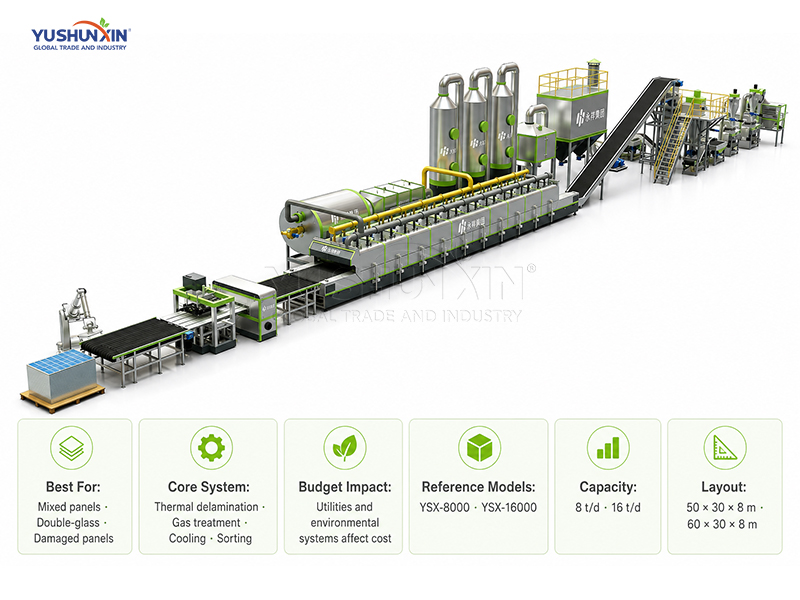
Thermal delamination suits mixed panels, double-glass modules, damaged panels, and difficult EVA layers. The project needs gas treatment, cooling, conveying, and downstream sorting. Therefore, utilities and environmental systems influence the budget. YSX-8000 and YSX-16000 target 8 t/d and 16 t/d. Their layouts need 50 × 30 × 8 meters and 60 × 30 × 8 meters.
Silver Recovery Needs
an Independent Budget
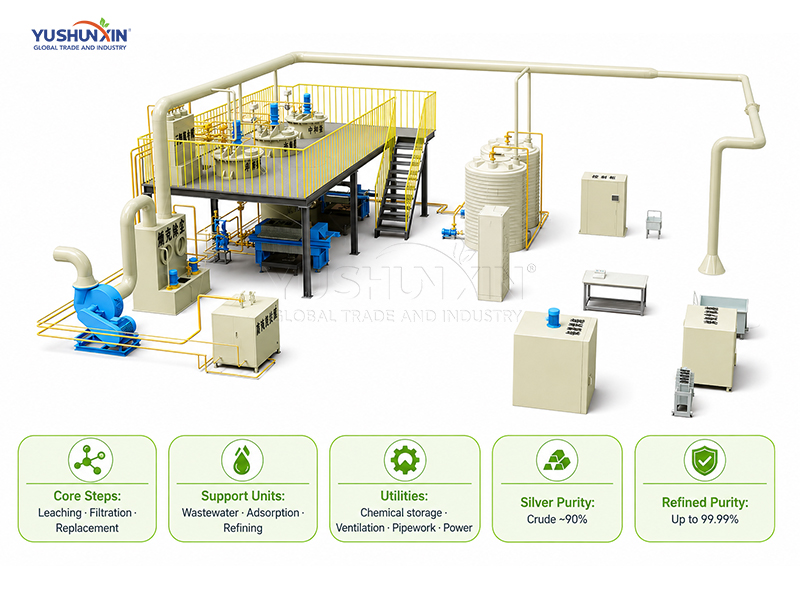
Silver extraction should not appear as one optional machine. The module needs leaching, filtration, replacement, wastewater treatment, adsorption, refining, drying, and melting. It also needs chemical storage, ventilation, pipework, and power distribution. Data covers rough silver near 90% purity. Further refining can reach 99.99% purity.
| Budget route | Suitable feedstock | Main products | Main cost driver |
| Mechanical recovery | Single-glass panels | Aluminum, glass, silicon-rich material | Product purity |
| Thermal delamination | Mixed or double-glass panels | Glass, silicon, copper, silver-rich fraction | Thermal and environmental scope |
| Silver refining | Concentrated cell material | Rough or refined silver | Grade, wastewater, compliance |
Which Budget Structure Supports Phased PV Recycling Plant Expansion?
Industrial buyers can divide investment into stages instead of purchasing every recovery module immediately. This approach protects cash flow and keeps future expansion practical. Therefore, the first design should reserve electrical, structural, control, and material-transfer interfaces. Yushunxin can supply standalone machines, functional modules, or a complete recycling line.
Start With Bulk Material Recovery Configuration
Bulk Material Recovery Configuration suits stable single-glass feedstock. YSX-1000 provides 1 t/h capacity with frame removal, glass separation and reserved expansion interfaces.
Expand Into Multi-Material Separation
Multi-Material Separation adds crushing, milling, gravity and electrostatic separation. Product purity, particle size and recovery targets define the required configuration.
Reserve Thermal And Refining Interfaces
Thermal and Refining Interfaces support mixed modules and future upgrades. Pyrolysis, gas treatment, silver concentration and refining can be added as expansion stages.
The preliminary budget can follow this formula:
Configured equipment budget = Base processing module + Selected recovery modules + Interface upgrades + Engineering allowance. Yushunxin can also cover design, manufacturing, installation, commissioning, and operator training. This structure aligns investment with feedstock growth and verified product markets.
How Do your Budget for Systems Beyond PV Recycling Line?
Equipment pricing covers only the machinery listed in the proposal. However, an industrial solar panel recycling plant also needs feedstock handling, utilities, buildings, compliance systems, and product storage. Therefore, buyers should separate equipment CAPEX from site interfaces. This approach prevents missing costs during construction and commissioning.
How Does Feedstock Handling Change the Entry Budget?
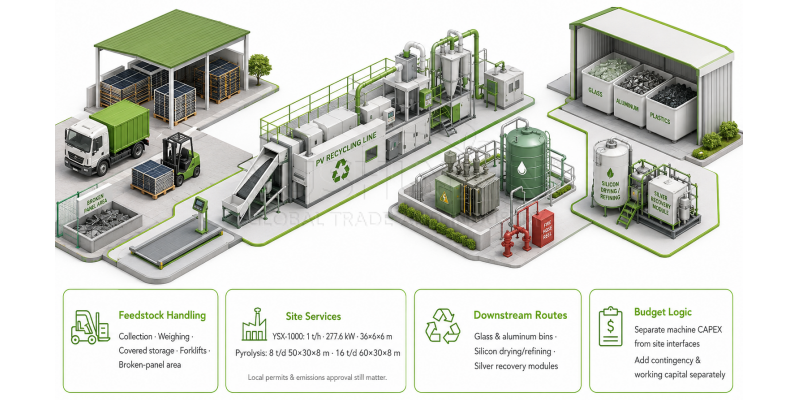
Complete modules require collection vehicles, weighing, covered storage, forklifts, and separate space for broken panels. Pre-dismantled laminates need fewer handling stages, but they may require tighter quality control. Therefore, identical throughput can produce different upstream budgets. Buyers should also reserve storage for frames, junction boxes, glass, and rejected material.
What Site Services Must Enter the Capital Plan?
The YSX-1000 mechanical line processes 1 t/h and requires about 277.6 kW. Its reference space measures about 36 by 6 by 6 meters. Meanwhile, 8 t/d and 16 t/d pyrolysis lines need larger heating, cooling, and emission systems. Their reference spaces reach 50 by 30 by 8 meters and 60 by 30 by 8 meters. Therefore, buyers must budget transformers, fuel supply, water circulation, ventilation, fire protection, and maintenance access. CE documentation supports listed YSX models, but local authorities still control permits and emissions approval.
Which Product Routes Add Downstream Investment?
Product strategy changes the capital plan. Glass, aluminum, silicon and silver recovery require different downstream modules, storage, refining and testing systems.
Get your Solution!Solar panel recycling plant cost depends on feedstock, process route, product grade, and project scope. Therefore, buyers should compare complete project assumptions instead of isolated machine prices. Yushunxin can provide mechanical recovery, thermal delamination, advanced separation, and silver recovery solutions. We can also define utilities, environmental systems, automation, installation, and future expansion interfaces. For further planning, we can provide you with solar panel recycling machine.
”
From Your Needs
to Real Impact


