

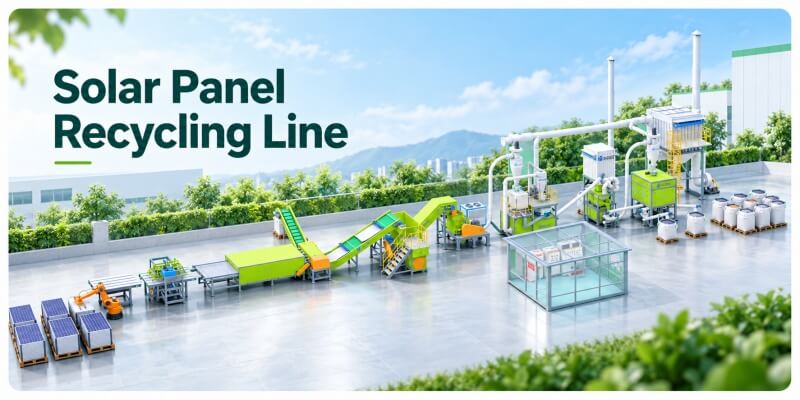










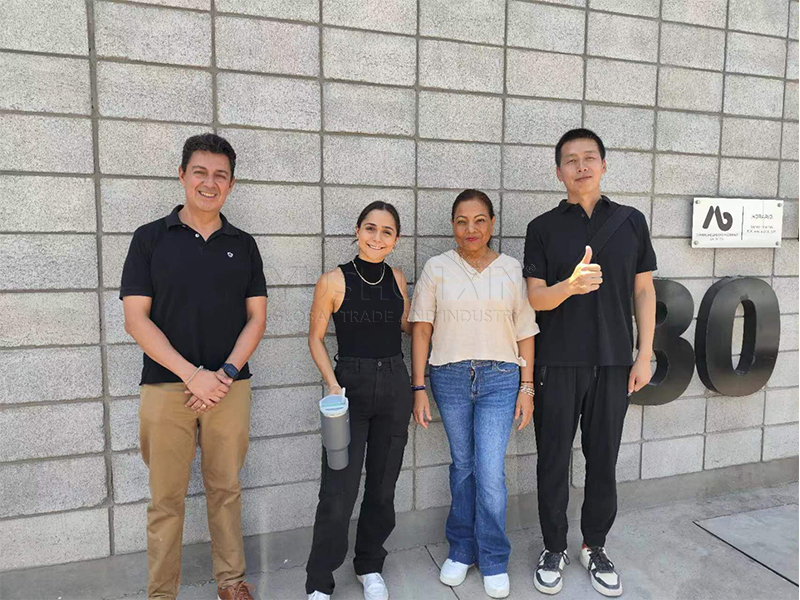

On April 6, 2025, an investor from Mexico contacted Yushunxin to discuss establishing a solar panel recycling plant. The customer planned to process approximately 0.5–1 ton of end-of-life photovoltaic modules per hour but did not know how much capital the project would require. For this capacity, Yushunxin can evaluate two main technical routes: A mechanical recycling line for single-glass solar panels and a pyrolysis and separation line for mixed single-glass and double-glass modules. Although both methods can recover aluminum, glass, silicon-bearing materials and metal fractions, they differ significantly in feedstock suitability, environmental systems, operating costs and initial investment.
Which Recycling Method Fits a $200,000 Budget PV Disposal Line?
The first step is not choosing machines. The investor must identify the type of waste solar panels available in Mexico. Single-glass modules normally contain one front glass layer, EVA encapsulant, crystalline-silicon cells and an organic backsheet. These panels can enter a mechanical dismantling, glass-removal, crushing, grinding and separation process. Double-glass modules contain glass on both sides. Their cells remain laminated between two glass layers, which makes direct mechanical glass removal more difficult. Mixed single-glass and double-glass feedstock usually requires pyrolysis process.
| Comparison | Mechanical Recycling Line | Pyrolysis Recycling Line |
| Main feedstock | Primarily single-glass PV modules | Mixed single-glass and double-glass modules |
| Reference capacity | 500–1,000 kg/h | 8 or 16 tons per day |
| Main process | Frame removal, glass removal, crushing, grinding and physical separation | Frame removal, oxygen-limited pyrolysis, gas treatment and multi-stage separation |
| Main environmental load | Dust and localized fumes from heated glass removal | Pyrolysis gas, combustion flue gas, dust and condensate |
| Main recovered fractions | Aluminum frame, glass, copper-rich particles, silicon/cell powder and plastic fraction | Aluminum, glass, silicon, copper, silver-rich cell material, pyrolysis oil and gas |
| Budget suitability | More suitable for a USD 200,000 startup project | Normally requires a higher project budget |
What Equipment Is Suitable for a 0.5–1 T/H Mechanical Solar Panel Recycling Line?
The original equipment list should not be described simply as a shredder, hammer mill, milling unit, gravity separator and electrostatic Separator. A complete mechanical photovoltaic recycling project contains several coordinated sections.
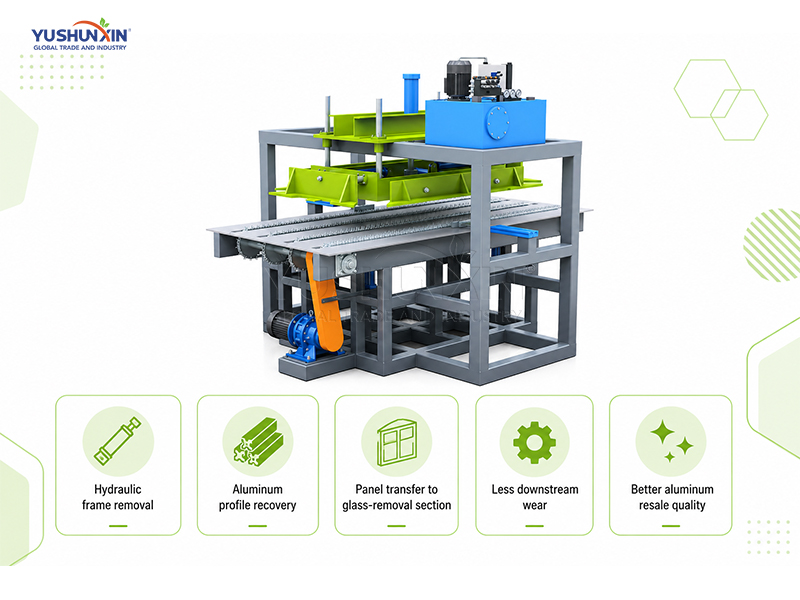
Solar Panel Frame Removal Machine
The frame removal machine uses a hydraulic system to separate the aluminum frame from the laminated module. It then transfers the remaining panel toward the glass-removal section. The machine recovers aluminum profiles as an independent product instead of allowing them to enter the crusher. This reduces downstream wear and improves aluminum resale quality.
| Item | Reference Data |
| Machine size | 5,800 × 2,600 × 2,100 mm |
| Weight | Approximately 3.8 tons |
| Capacity | 60–80 panels per hour |
| Power | 16 kW |
| Suitable panel length | 1,600–2,200 mm |
| Suitable panel width | 900–1,300 mm |
Solar Panel Glass Removal Machine
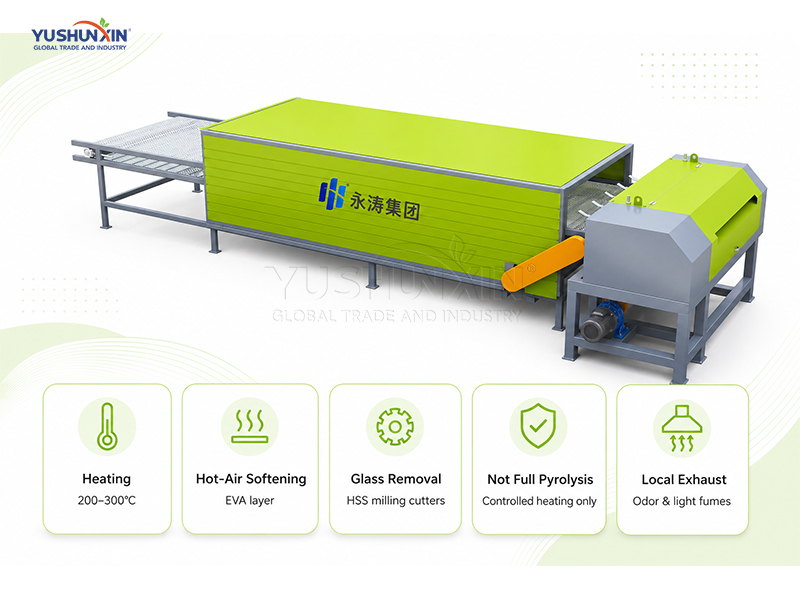
After frame and junction-box removal, the single-glass laminate enters the glass-removal machine. The system first heats the panel at approximately 200–300°C. Hot-air circulation softens the EVA bonding layer. The panel then enters the mechanical glass-removal section, where multiple HSS milling cutters remove the front glass. This process is different from full pyrolysis. It uses controlled heating to assist mechanical glass removal, but it does not thermally decompose the entire module inside a pyrolysis reactor. The customer should still install localized exhaust collection around the heating and glass-removal section because softened EVA and backsheet materials may release odor or a small amount of fumes.
| Item | Reference Data |
| Machine size | 6,120 × 4,945 × 3,500 mm |
| Weight | Approximately 5 tons |
| Capacity | 60–80 panels per hour |
| Power | 36 kW |
| Glass-removal structure | 44 sets of milling cutters |
Single-Shaft Shredder
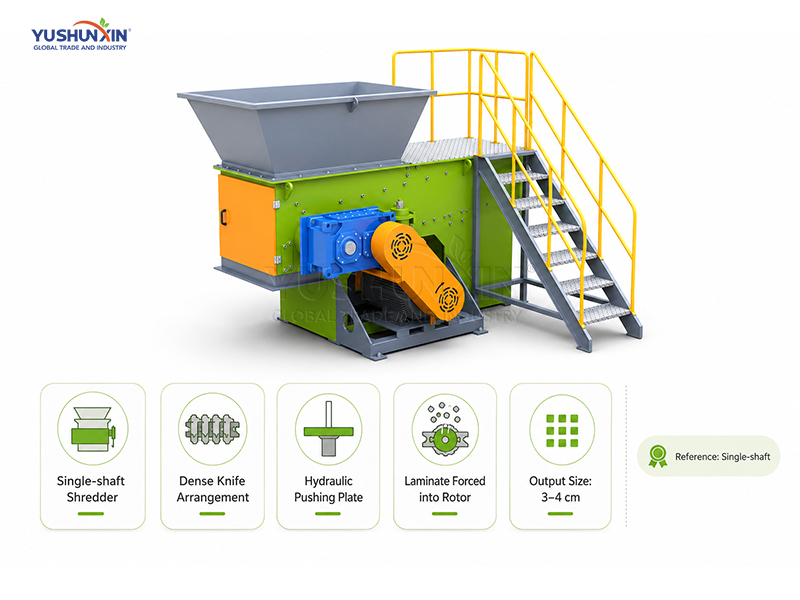
The standard reference configuration uses a single-shaft shredder rather than a double-shaft shredder. The machine has a dense knife arrangement and a hydraulic pushing plate. It forces the remaining laminate into the rotor and reduces it to pieces of approximately 3–4 cm. A double-shaft shredder may still be selected for heavily damaged, mixed or irregular panels. However, it should be presented as a customized option rather than the default machine in this project.
| Item | Reference Data |
| Machine size | 3,500 × 1,800 × 2,200 mm |
| Weight | Approximately 6.5 tons |
| Reference capacity | 800–1,200 kg/h |
| Power | 75 kW |
| Rotor speed | Approximately 35 r/min |
Hammer Crusher
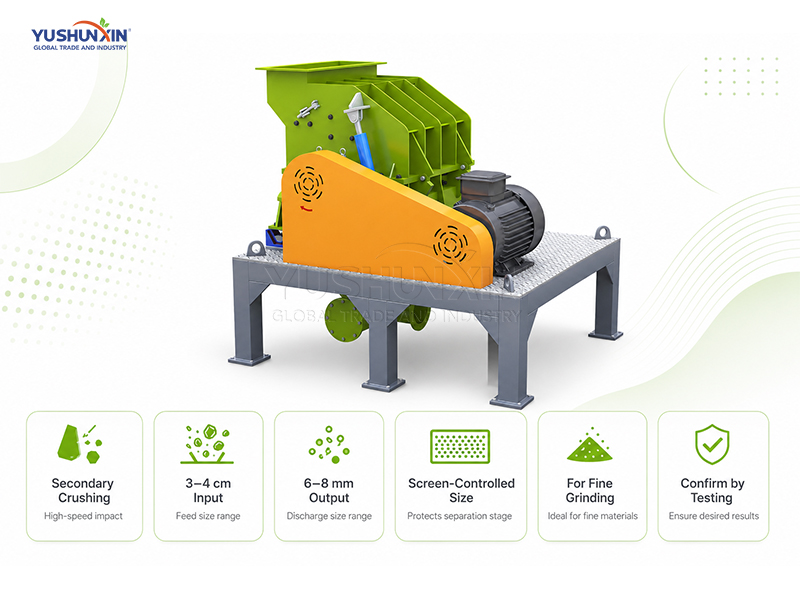
The hammer crusher performs secondary size reduction after shredding. High-speed hammers apply impact, collision and shearing forces to reduce the 3–4 cm pieces to approximately 6–8 mm. A discharge screen controls the final particle size. The crusher prepares the material for fine grinding and prevents oversized glass or laminate pieces from entering the separation section. Because the single-machine capacity data in the source table does not match the documented 1 t/h complete line, the final crusher model, rotor power and screen aperture should be confirmed through engineering calculation and sample testing.
Grinding Mill
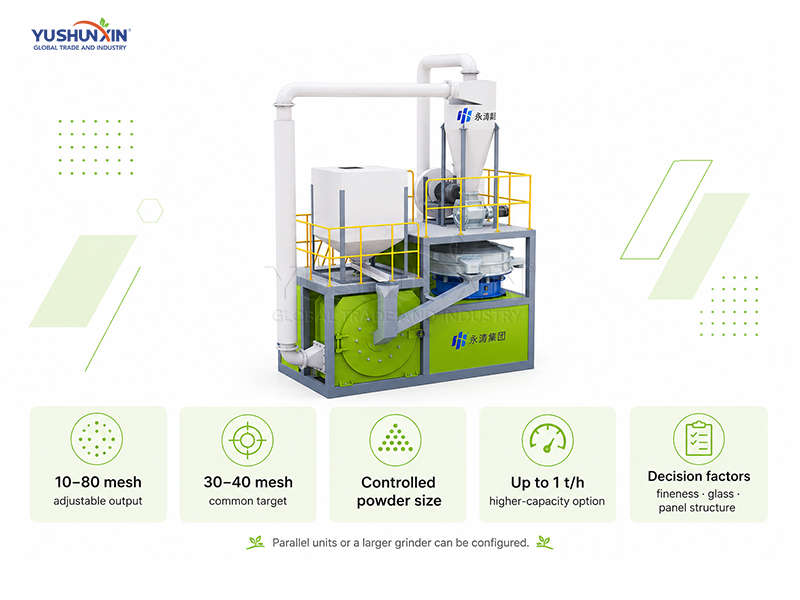
After hammer crushing, the turbine grinding mill reduces the material to a controlled powder size. Depending on the separation target, the system can produce approximately 10–80 mesh material, while 30–40 mesh is a common operating target. For a line operating near the upper limit of 1 t/h, Yushunxin may configure two grinding units in parallel or select a larger grinding system. The final decision depends on required fineness, glass content and actual panel structure.
| Item | Reference Data |
| Machine size | 1,800 × 1,500 × 2,200 mm |
| Weight | Approximately 2.5 tons |
| Reference capacity | 300–800 kg/h |
| Power | 55 kW |
| Rotor speed | Approximately 2,800 r/min |
Pneumatic Conveying and Screening System
Fine powder should not move between machines through open manual handling. The line uses pneumatic conveying to transfer ground material through enclosed pipelines. A cyclone collector or receiving hopper separates the material from the conveying air before it enters a rotary or vibrating screen. The screen performs particle-size classification. Oversized particles can return to the grinding section, while qualified powder continues to gravity and electrostatic separation. This closed transfer route reduces dust leakage, manual bag handling and cross-contamination.
Airflow Gravity Separator
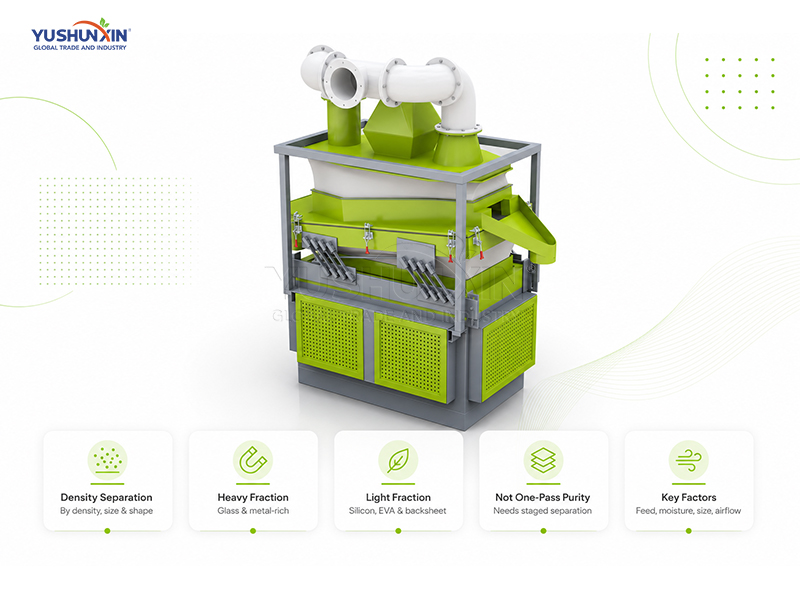
The airflow gravity separator uses differences in particle density, size, shape and settling velocity. It separates heavier glass and metal-rich particles from lighter silicon, EVA and backsheet fractions. The separator does not produce final-purity products in one pass. Feed uniformity, moisture, particle-size distribution and airflow settings directly affect separation efficiency.
| Item | Reference Data |
| Machine size | 3,500 × 2,500 × 3,000 mm |
| Weight | Approximately 2.8 tons |
| Reference capacity | 3–5 t/h |
| Fan power | 22 kW |
| Vibration motor power | 2 × 1.1 kW |
Electrostatic Separator
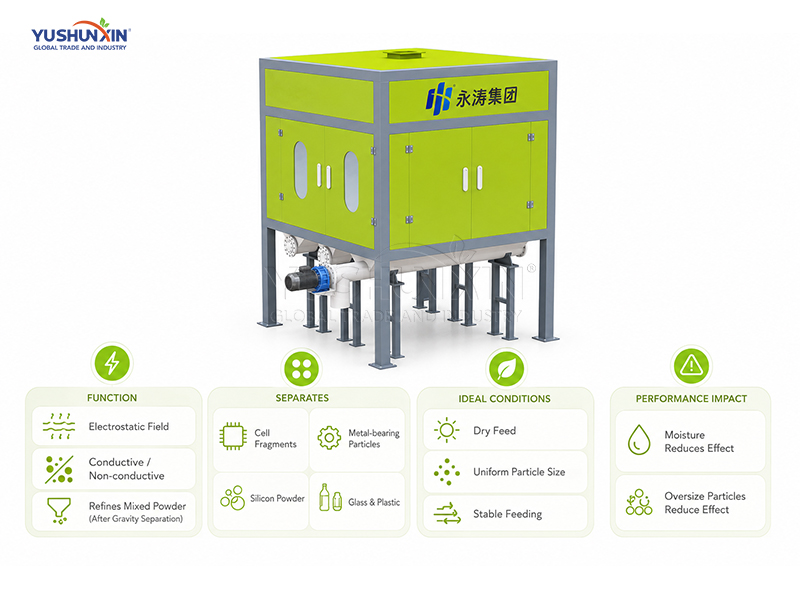
The electrostatic separator refines mixed powder that gravity separation cannot completely divide. The machine creates a high-voltage electrostatic field. Conductive and non-conductive particles follow different trajectories, allowing the system to concentrate cell fragments, metal-bearing particles, silicon powder, glass and plastic fractions.
Pulse Dust Collection System
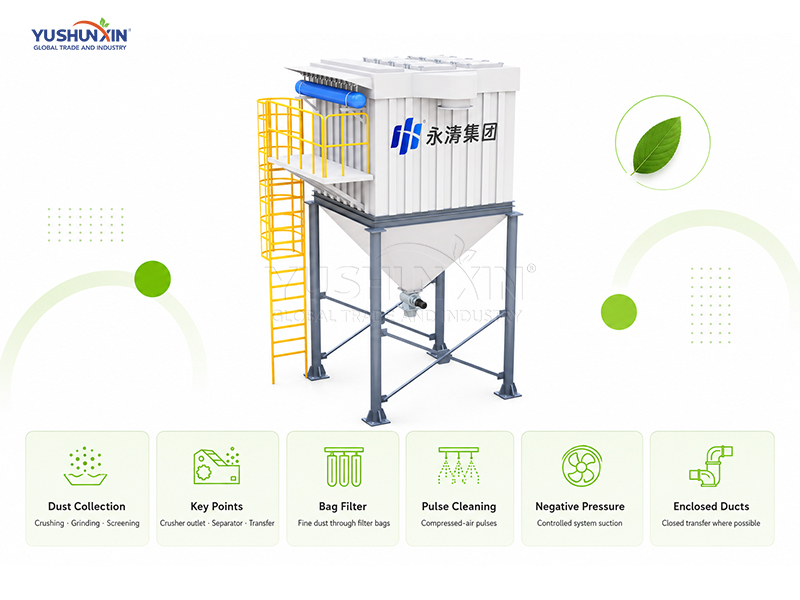
Mechanical recycling does not mean that the line has no environmental-control requirements. Frame removal, glass removal, crushing, grinding, screening and material transfer all generate dust. Therefore, the project should place dust-collection points around the crusher outlet, grinding mill, screen, gravity separator and transfer interfaces. A pulse-jet baghouse collects fine dust through filter bags. Compressed-air pulses periodically remove accumulated dust from the bags and discharge it into the hopper. The system should operate under controlled negative pressure and use enclosed ducts wherever possible.
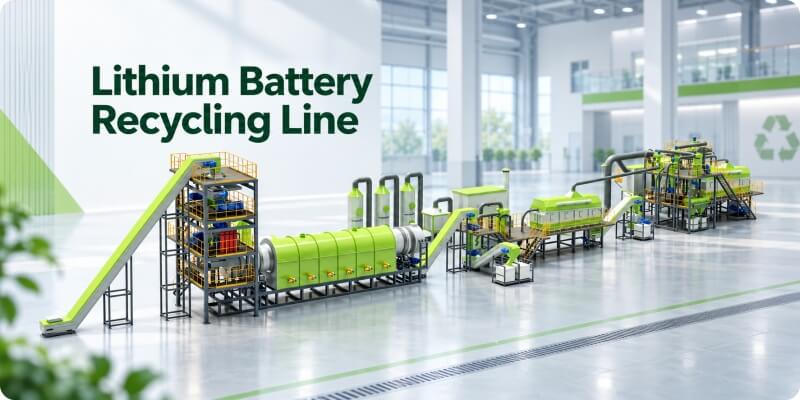
When Should the Customer Choose Solar Panel Pyrolysis Recycling Instead?
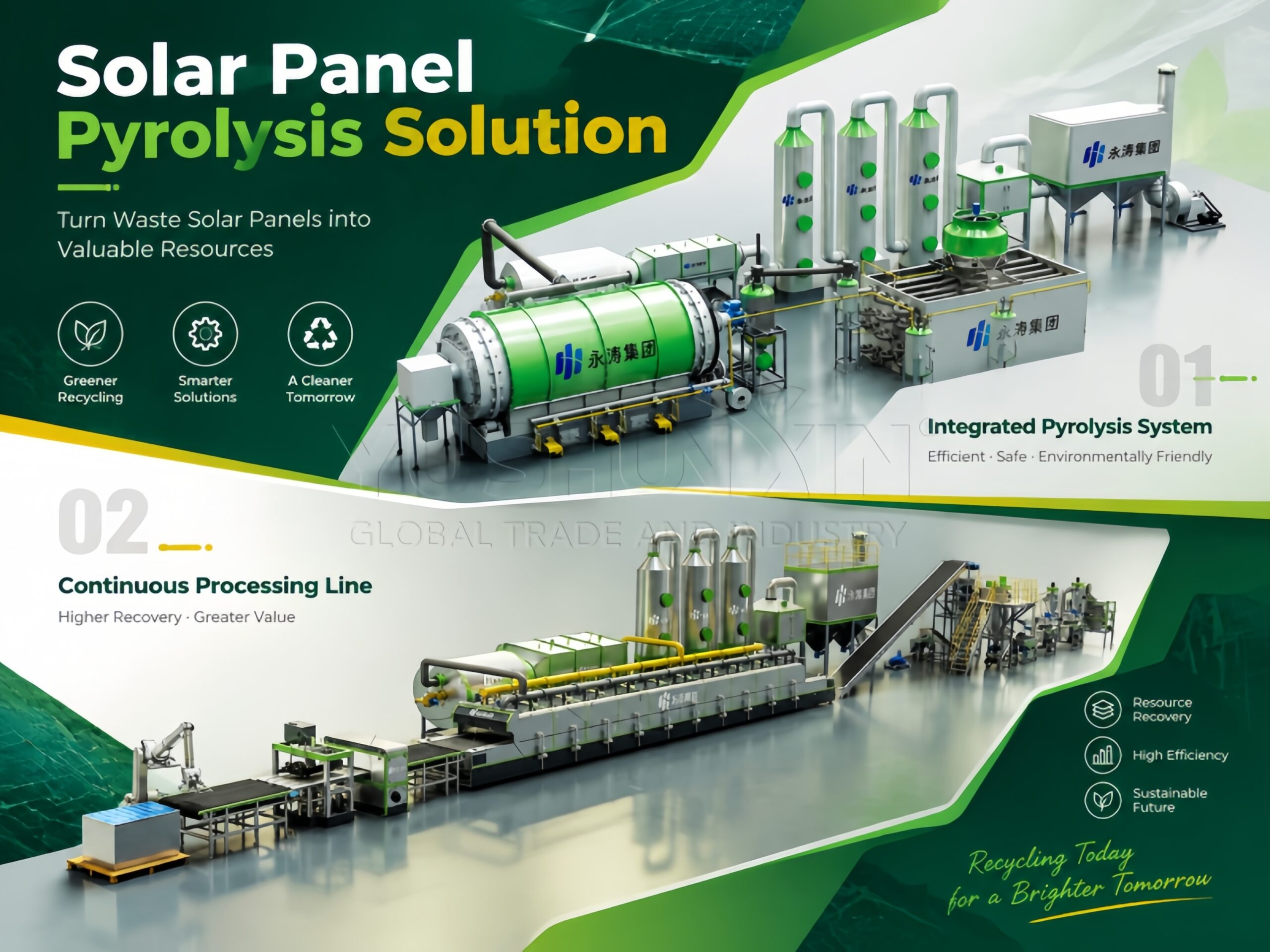
The mechanical route is not the best solution for every photovoltaic waste stream. When the customer receives double-glass modules, heavily laminated mixed panels or material that cannot pass through the glass-removal machine efficiently, Yushunxin can configure a pyrolysis and separation line. The documented reference models include:
Integrated Pyrolysis Process and Material Recovery Flow
The process includes aluminum-frame removal, controlled pyrolysis, oil-gas separation, condensation, syngas reuse, solid discharge and multi-stage material separation. During pyrolysis, the EVA and organic backsheet components decompose. Condensable vapors can form a liquid fraction, while non-condensable gas can return to the heating system. The solid output contains glass, silicon, copper and silver-bearing cell material, which then enters screening and separation.
| Model | Processing Capacity | Pyrolysis Furnace Size | Reference Land Requirement |
| YSX-8000 | 8 t/day | 2,200 × 6,000 × 20 mm | 50 × 30 × 8 m |
| YSX-16000 | 16 t/day | 2,800 × 6,600 × 18 mm | 60 × 30 × 8 m |
Choosing the right solar panel recycling solution depends on module type, processing capacity, recovery targets and investment conditions. Mechanical recycling suits stable single-glass panel streams, while pyrolysis systems are suitable for mixed modules and higher-value material recovery. Yushunxin provides customized recycling solutions based on actual project requirements.
”
From Your Needs
to Real Impact


