

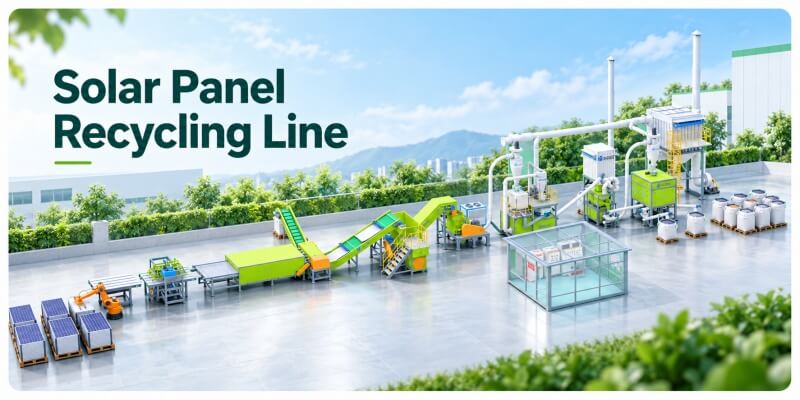










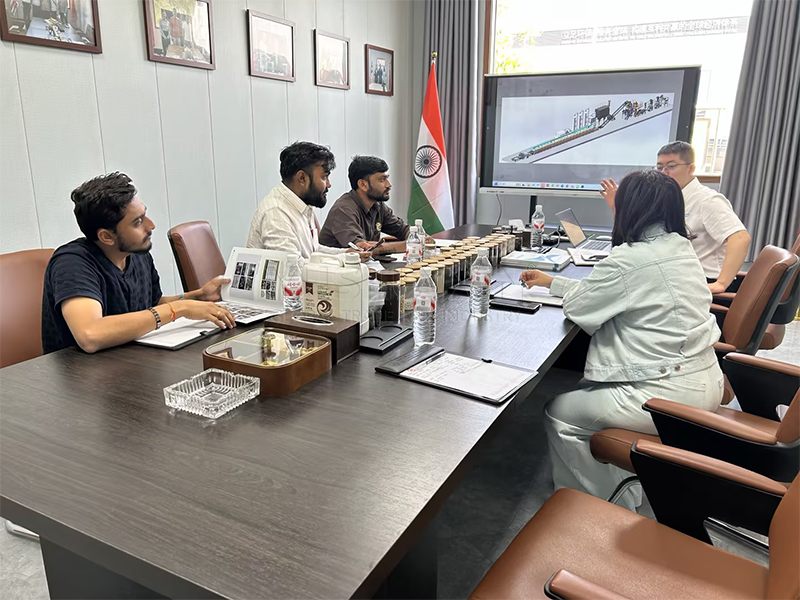

On 16th June 2025, a customer from India inquired us about solar panel recycling with pyrolysis method. “We are preparing to recycle solar panels in India. Now we start thinking to use pyrolysis method to recycle waste solar panels, so please send us the cost of full line to process about 1000kg/hour.” For this, we send him a pyrolytic solar panel recycling line. The following are the specific details of communication in this case:
What is the design of a 1000kg/h pyrolytic solar panel recycling in India?
For this Indian project, YUSHUNXIN recommended a continuous tunnel-furnace pyrolysis line designed around the following process:
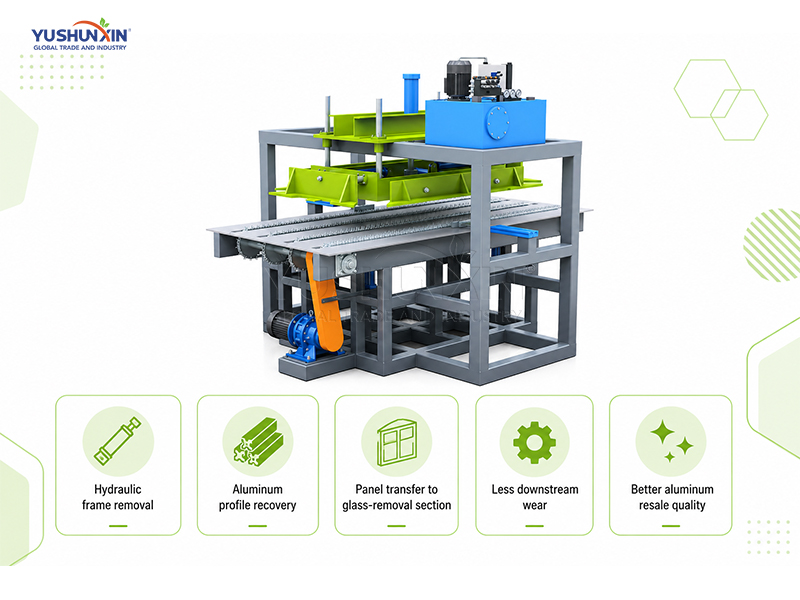
Aluminum Frame Removal
The line first removes the junction boxes and aluminum frames. Removing these materials before pyrolysis provides several advantages: Aluminum frames can enter the metal recycling market directly. The furnace does not need to heat unnecessary external components. And modules enter the furnace in a more consistent shape. For reference, the YUSHUNXIN A-800 frame-removal machine processes approximately 60–80 panels per hour. It uses 16 kW of power and accepts modules approximately 1,600–2,200 mm long and 900–1,300 mm wide. The final model must match the actual dimensions and weight of the Indian customer’s modules.
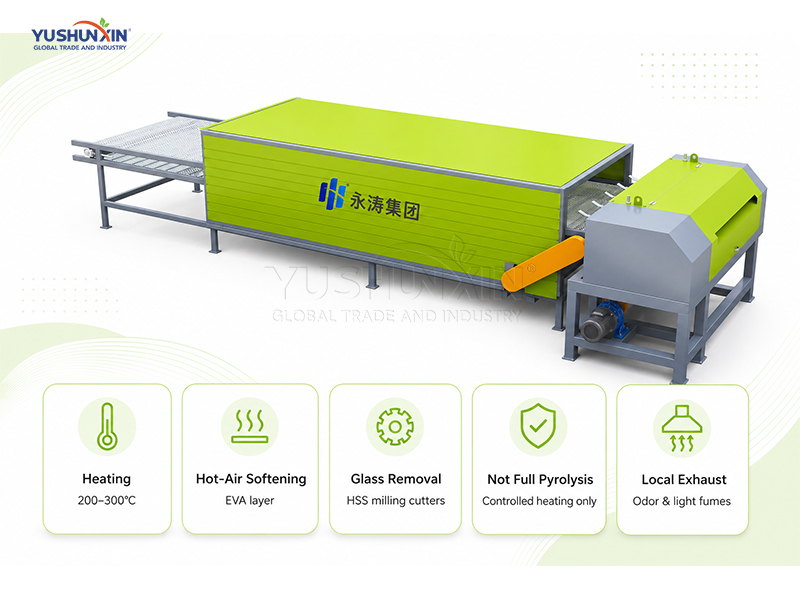
Should the Line Include a Glass-Removal Machine?
A glass-removal machine is not automatically installed before a mixed-panel pyrolysis system. For single-glass modules, mechanical glass removal can recover relatively clean glass before the remaining laminate enters crushing and separation. For a mixed single-glass and double-glass pyrolysis project, the front-end design normally follows this configuration: whole-panel or flattened-panel feeding. This method suits single-glass modules when the customer wants to retain larger glass pieces. After removing the frame and junction box, the panel is flattened and enters the tunnel furnace without complete glass removal. Therefore, the Indian customer’s final feed-preparation system should be selected according to the single-glass and double-glass ratio rather than using one fixed glass-removal machine.
How Does the Tunnel Furnace Separate EVA From the PV Materials?
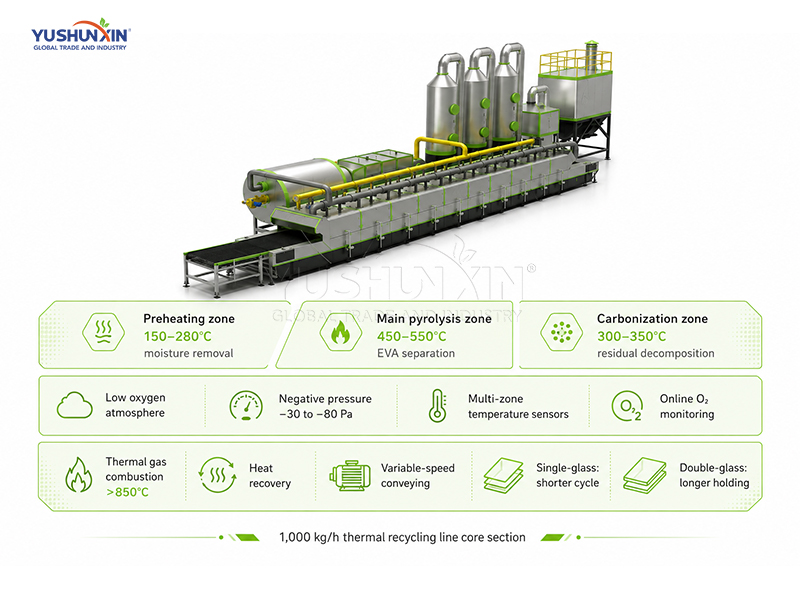
The tunnel furnace is the core of the 1,000 kg/h thermal recycling line. A typical industrial tunnel furnace uses several controlled heating zones rather than one fixed temperature.
Low-Oxygen and Negative-Pressure Operation
The system maintains a controlled low-oxygen atmosphere and slight negative pressure. This design reduces the risk of thermal gas escaping into the workshop and prevents excessive oxidation. A reference control range for the furnace is approximately −30 to −80 Pa. Multiple temperature sensors monitor the different furnace zones. The control system can maintain temperature fluctuations within an agreed operating range and adjust the induced-draft fan automatically. An online oxygen-monitoring system can also be installed. When oxygen exceeds the preset safety limit, the system issues an alarm, introduces protective gas where required and adjusts the exhaust or heating system.
Thermal-Gas Combustion and Heat Recovery
EVA and backsheet materials release combustible gases during pyrolysis. Instead of discharging these gases directly, the line sends them into a high-temperature combustion chamber. The combustion temperature can be maintained above 850°C for further thermal treatment of organic compounds. Recovered heat can return to the tunnel furnace and reduce part of the external heating demand. Electric auxiliary heating or another approved heat source can support furnace startup, low-load operation and temperature stabilization.
Conveying Speed and Residence Time Optimization
The furnace usually adopts variable-speed, heat-resistant conveying equipment. The engineering team adjusts the conveying speed and residence time according to panel thickness, glass structure, EVA content and target separation quality. Single-glass modules generally require a shorter heating cycle. Double-glass modules need slower heating and a longer holding period because heat must pass through two layers of glass before reaching the EVA and cell layers.
Get your Solution!How to Separate the Pyrolyzed Materials from Solar Panel Pyrolysis?
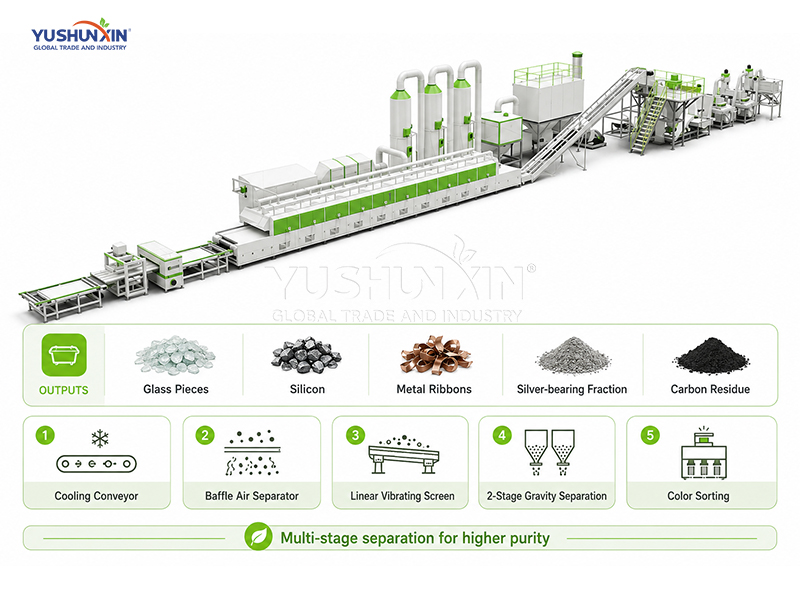
After the pyrolysis process, solar panel materials are separated from the encapsulation layers, but the recovered output is still a mixed stream containing several valuable components. Since glass, silicon, metal ribbons, silver-bearing materials and carbon residues have different physical properties, a single separation method cannot achieve the required product purity. Therefore, the project adopts a multi-stage separation system that combines cooling, air separation, screening, gravity separation and optical sorting technologies to gradually concentrate each valuable material and improve overall recovery efficiency.
Cooling Chain Conveyor
The hot material first enters a heat-resistant chain conveyor or cooling section. Controlled cooling stabilizes the material and reduces the risk of hot carbon residue contacting air suddenly.
Multi-Stage Separation for High-Purity Material Recovery
Baffle Air Separator
Linear Vibrating Screen
Two-Stage Gravity Separation
Color Separation
Can you offer parameters of solar panel recycling machine?
Of course. YUSHUNXIN will provide detailed parameters for solar panel disposal plan machines when discussing system layout according to capacity and raw material… conditions. For example, for the 1000kg/h pyrolytic solar panel recycling line to India, the main machines have the following specifications:
| Project item | Reference design basis |
| Nominal input capacity | Approximately 1,000 kg/h |
| Suitable feed | Single-glass, double-glass or mixed crystalline-silicon PV modules |
| Main thermal equipment | Continuous low-oxygen tunnel furnace |
| Main pyrolysis temperature | Approximately 450–550°C |
| Combustion-chamber temperature | At least 850°C under the agreed process |
| Typical tunnel-furnace length | Approximately 28–40 m, depending on module structure and residence time |
| Reference installed power | Calculated after configuration; 1–5 t/h systems may use approximately 300–800 kW |
| EVA delamination target | Up to ≥99% under agreed feedstock and test conditions |
| Silicon recovery reference | Up to ≥98% with the complete downstream process |
| Complete-glass recovery reference | Up to ≥92% for a suitable whole-panel single-glass route |
| Main products | Aluminum, glass, silicon, copper ribbons and silver-bearing fractions |
| Control method | PLC, variable-frequency drives, temperature monitoring, pressure and oxygen interlocks |
The above are details about our communication with the customer about how much is solar panel recycling in India. In addition, we can also provide you with many other e-waste disposal plans. Such as lithium battery recycling line, waste tire pyrolysis machine, mechanical solar panel recycling plant, etc. Welcome to contact us for best solution for your solar panel recycling plant now!
”
From Your Needs
to Real Impact


