












Solar panel recycling plant cost changes with feedstock structure, target product quality, and supply scope. Mechanical separation, pyrolysis, and silver extraction require different equipment packages. Moreover, automation, emission control, and site utilities can increase total project CAPEX. This FAQ explains which configuration choices affect your final investment most.
How Does the PV Recycling Line Match Different PV Module Structures?
Module structure should determine the recycling route before suppliers calculate the line price. Single-glass panels may suit mechanical separation, while mixed modules often need thermal delamination. Therefore, buyers should confirm panel ratios, laminate strength, and required glass condition first. This decision changes the core equipment, power demand, footprint, and environmental package.
Configure Mechanical Separation for Defined Single-Glass Feedstock
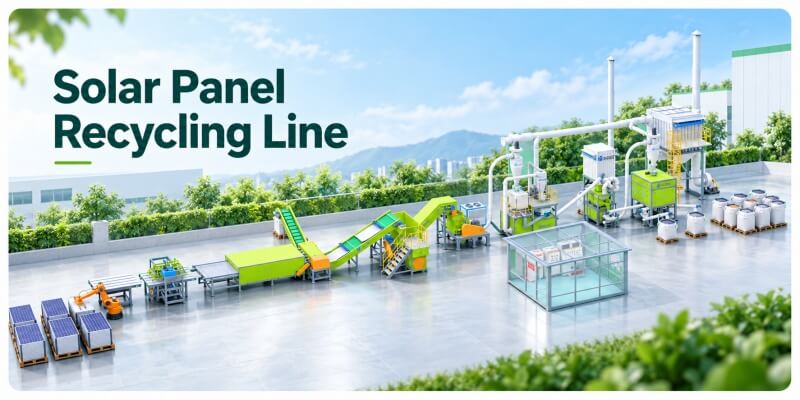
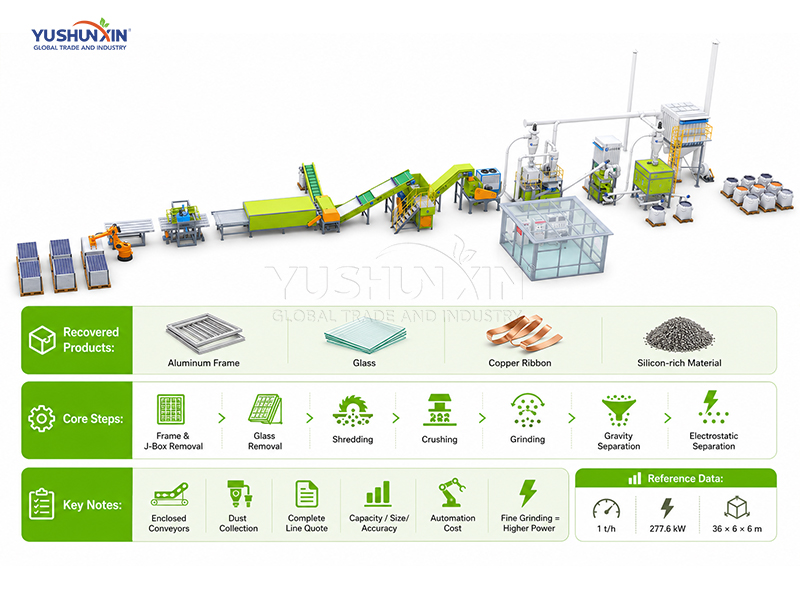
Single-glass modules usually contain one glass layer, EVA, cells, and a polymer backsheet. A mechanical line first removes the aluminum frame and junction box. Then, a glass removal unit separates glass from the remaining laminate. Shredding, crushing, grinding, gravity separation, and electrostatic separation complete the recovery route. Meanwhile, enclosed conveyors and dust collection control fine glass and silicon powder. Therefore, the quotation must cover the complete line, not one crusher. Price changes with hourly capacity, panel dimensions, recovered glass size, and final separation accuracy. Automation also changes feeding, transfer, and discharge costs. Moreover, finer grinding requires higher power and stronger dust control. A reference mechanical PV recycling line processes about 1 t/h. It uses about 277.6 kW and needs a 36×6×6 m layout. This scale confirms that the system requires coordinated equipment and material flow.
Add Thermal Delamination for Mixed and Double-Glass Feedstock
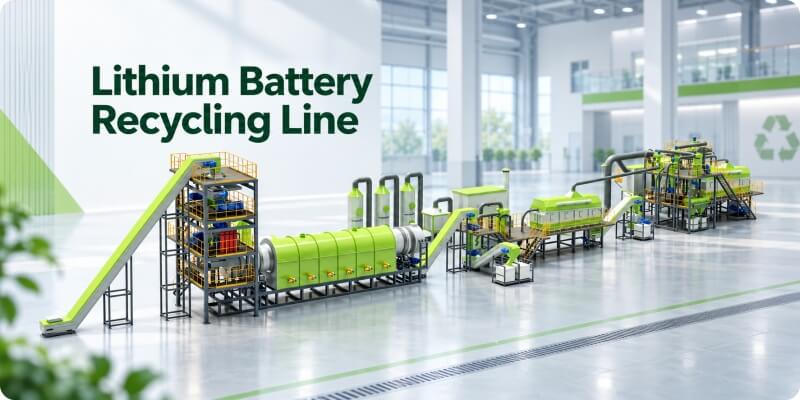
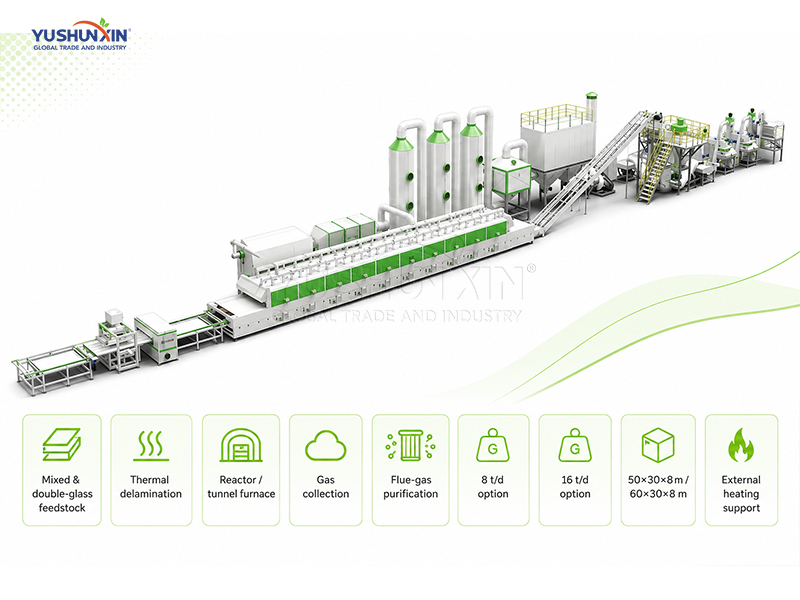
Double-glass modules place cells between two bonded glass layers. EVA keeps the glass, cells, and ribbons tightly laminated. Direct mechanical separation may increase breakage and product contamination. Therefore, mixed-feed projects often need pyrolysis or tunnel-furnace delamination. Thermal treatment loosens the laminate before screening and physical separation. This route adds a reactor or tunnel furnace, controlled feeding, and a combustion chamber. It also adds temperature control, negative pressure, gas collection, cooling, and flue-gas purification. Consequently, price changes with capacity, furnace structure, heating zones, refractory design, and separation depth. Batch, semi-continuous, and continuous systems also create different automation requirements.
Can one mechanical line process every retired module?
Not reliably. Mechanical separation suits defined single-glass feedstock and clear recovery targets. However, strongly laminated or double-glass modules may resist direct mechanical separation. Therefore, suppliers should test representative panels before finalizing the route.
Solar panels also generate limited combustible gas during thermal treatment. Thus, the system may require continuous external heating and a larger fuel supply package. Therefore, buyers should compare quotations using the same panel mix and processing route. A mechanical quotation cannot replace a complete thermal recycling proposal.
How Do You Configure PV Disposal Line for Different Product Grades?
Your target product grade directly determines the required separation depth. Basic outputs need fewer machines and simpler controls. However, higher-purity silicon or silver products require additional processing stages. Therefore, define buyer specifications before finalizing the production line.
Configure Standard Separation
for Marketable Bulk Outputs
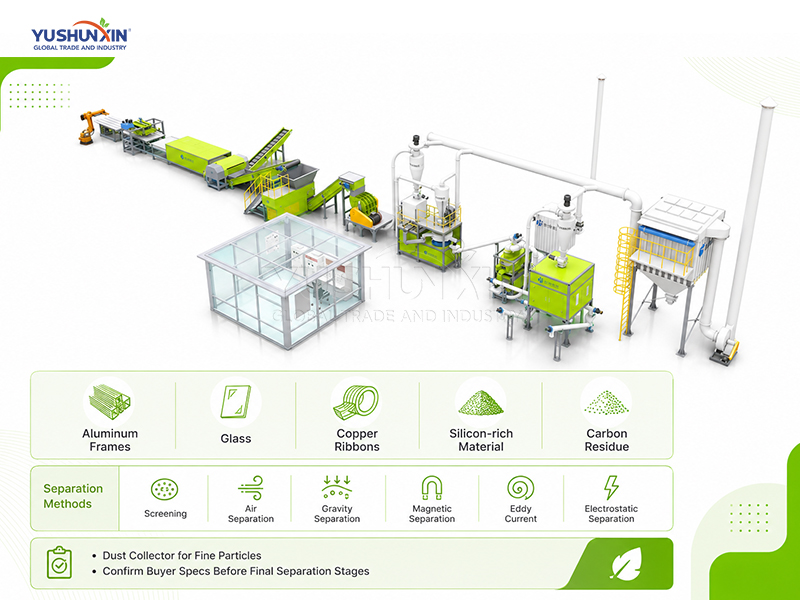
Standard Separation recovers Marketable Bulk Outputs including aluminum, glass, copper, silicon-rich material and carbon residue. Screening, airflow, gravity, magnetic and electrostatic separation should match product requirements.
Add Dedicated Silver
Section For Higher Value
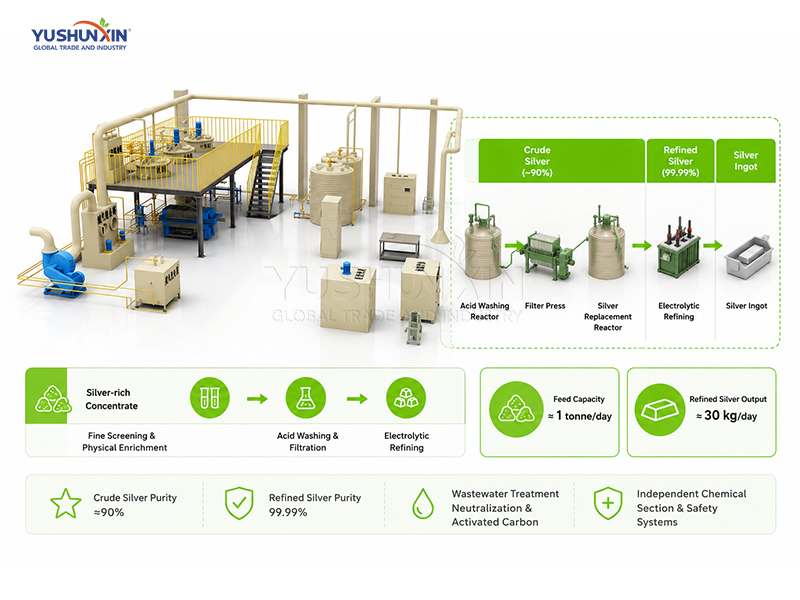
Dedicated Silver Section upgrades Silver-rich concentrate into Crude silver or Refined silver ingot. Acid washing, filtration, replacement and electrolysis improve silver purity and product value.
Customer question: Does the standard recycling line produce finished silver ingots?
The standard line usually produces silver-bearing concentrate. Finished ingots require chemical extraction and electrolytic refining. Therefore, quote the silver section as a separate investment package. Match the product grade with confirmed buyers and operating capability. Higher purity only creates value when the market pays for it.
How Should Buyers Define the Supply Boundary Before Estimating Total CAPEX?
Two suppliers may price the same project differently because each proposal covers a different supply boundary. One quotation may include only core machines. Meanwhile, another may include feeding, environmental control, automation, installation, and commissioning. Therefore, buyers should compare identical supply scopes before evaluating the final investment.
What Affects the Cost of a Solar Panel Recycling Plant
A core equipment price does not represent a production-ready recycling plant. It may cover dismantling, crushing, pyrolysis, or primary separation equipment. However, the complete line also needs material transfer, environmental control, safety systems, and automatic operation.
| Price Level | Typical Scope |
| Core equipment price | Dismantling, glass removal, crushing, pyrolysis, or primary separation equipment |
| Complete production line price | Feeding, conveying, cooling, dust control, separation, PLC control, and safety systems |
| Delivered equipment price | Equipment, sea freight, insurance, port charges, and inland transport |
| Installed project cost | Installation, lifting, commissioning, training, and local construction support |
| Total project CAPEX | Equipment, civil works, utilities, permits, taxes, laboratory, and working capital |
Buyers should confirm whether the quotation includes feeding, discharge, conveyors, cooling, gas treatment, and dust collection. Moreover, the scope should define PLC cabinets, safety devices, spare parts, commissioning, and operator training. A supplier can reduce the initial price by removing these supporting systems. However, the customer must purchase them before production starts. Therefore, the lowest equipment price may create a higher total project cost.
What Affects the Cost of a Solar Panel Recycling Plant
Most equipment quotations exclude buildings, foundations, utility connections, fire systems, permits, and local taxes. Therefore, buyers should estimate these costs during technical configuration, not after equipment delivery. A pyrolysis and separation section can require about 1,000–1,500 square metres for medium industrial capacities. Moreover, a silver extraction section may require another 200 square metres. Cooling systems may also need an 8–10 cubic metre circulating water tank.
| Local Cost Area | Main Budget Items |
| Civil works | Factory building, equipment foundations, drainage, and maintenance access |
| Utilities | Transformer, electrical connection, fuel supply, process water, and compressed air |
| Environmental systems | Ventilation ducts, emission stack, monitoring interfaces, and wastewater facilities |
| Safety facilities | Fire protection, emergency access, chemical storage, and safety barriers |
| Project approval | Local permits, engineering review, taxes, and conformity documentation |
European projects may require compliant electrical components, guarding, interlocks, emergency stops, and detailed technical files. Yushunxin’s solar panel and e-waste recycling equipment has conformity certification covering machinery and electromagnetic compatibility requirements. The assessment references 2006/42/EC and 2014/30/EU requirements. However, equipment certification cannot replace local construction, fire, or emission permits. Therefore, the customer should confirm these requirements with local engineering and regulatory partners.
What Affects the Cost of a Solar Panel Recycling Plant
The quotation covers only the listed supply scope. Local construction, utilities, installation, permits, and taxes may remain outside the price. Therefore, each proposal should include a clear responsibility matrix.
| Project Responsibility | Supplier | Customer | Local Contractor |
| Process design | ✓ | ||
| Equipment manufacturing | ✓ | ||
| Site data confirmation | ✓ | ||
| Civil foundation | ✓ | ✓ | |
| Utility connection | ✓ | ✓ | |
| Installation guidance | ✓ | ✓ | |
| Local permits | ✓ | ✓ | |
| Commissioning | ✓ | ✓ |
A reliable proposal should define included equipment, exclusions, utility loads, and installation responsibilities. Therefore, buyers can estimate total CAPEX before approving the project.
Solar panel recycling plant cost depends on the process route, target product grade, and confirmed delivery boundary. Therefore, buyers should compare proposals using the same feedstock, output standards, and project scope. Yushunxin can design mechanical, pyrolysis, separation, and silver extraction solutions for different industrial projects. We can also define utilities, automation, environmental controls, installation duties, and local project interfaces.
”
From Your Needs
to Real Impact


