














A lithium battery recycling machine price starts with feedstock, product targets, and operating conditions Residual charge, battery format, black mass grade, and annual throughput change the process route. Moreover, discharge, dust control, utilities, and downstream refining can extend investment beyond the core line. Yushunxin can build phased budget options around your project data. This article also provides formulas for estimating CAPEX, operating cost, and payback.
How Does Feedstock Risk Define the First Lithium Battery Recycling Equipment Budget?
Industrial budgets should start with representative batteries, because equal throughput does not require equal equipment. Battery format, chemistry, residual charge, and dismantling level change the process route. Therefore, Yushunxin defines the incoming material before pricing the line.
Build the Budget Around the Actual Battery Stream
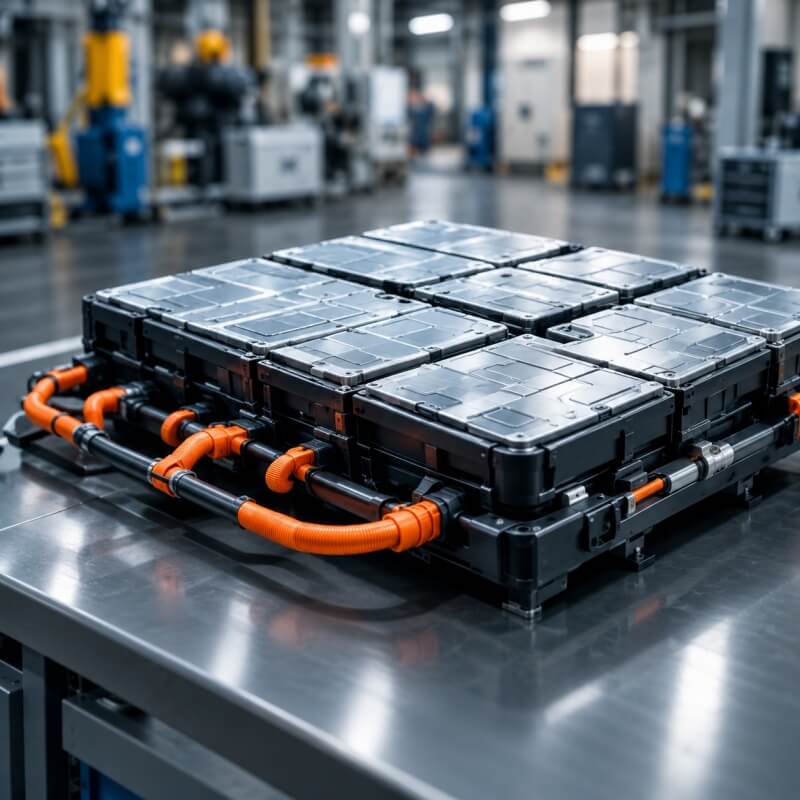
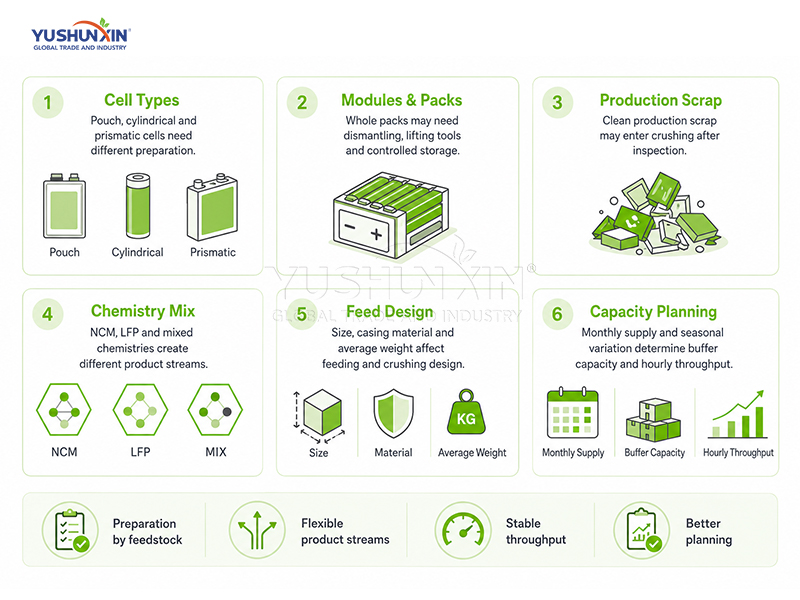
Pouch cells, cylindrical cells, prismatic cells, modules, packs, and production scrap need different preparation. Whole packs may require dismantling stations, lifting tools, and controlled storage. However, clean production scrap may enter crushing after inspection. NCM, LFP, and mixed chemistries also create different product streams. Battery dimensions, casing materials, and average weight affect feeding and crushing design. Meanwhile, monthly supply and seasonal variation determine buffer capacity and hourly throughput.
Price Residual-Charge Control as a Separate Safety Module
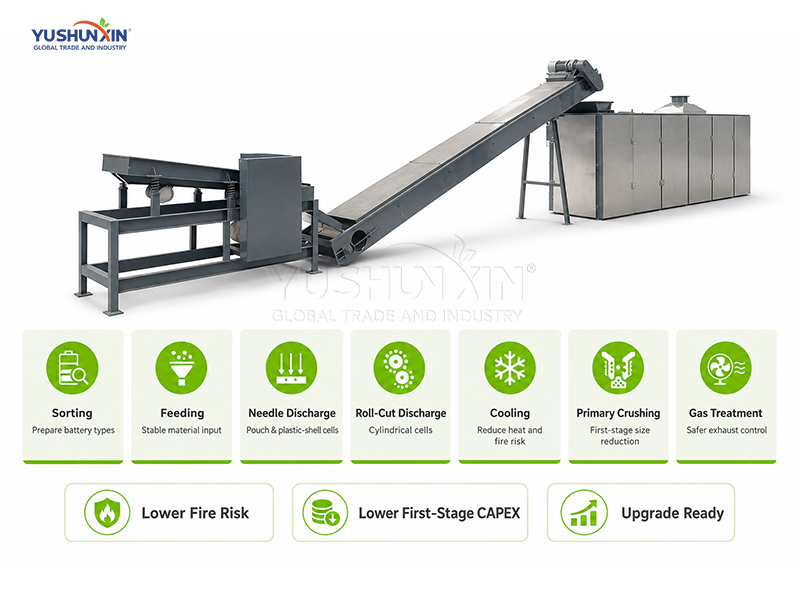
Residual charge changes project CAPEX. Charged batteries may require discharge equipment, cooling conveyors, smoke collection, odor treatment, and fire separation. Yushunxin uses needle discharge for pouch and plastic hard-shell cells. Cylindrical cells can use roll-cut discharge instead. Discharged batteries then enter cooling and downstream crushing. One reference system uses a 6,000 mm stainless-steel conveyor. It also includes 15,000 m³/h activated-carbon treatment and UV odor control. These modules should appear separately in the budget.
Lithium Battery Recycling Machine Price
| Feedstock evidence | Budget effect | Possible response |
| Battery format | Feeding and discharge route | Needle or roll-cut discharge |
| Pack condition | Dismantling workload | Manual or automated stations |
| Residual charge | Fire and cooling scope | Discharge and cooling modules |
| Moisture and electrolyte | Gas-treatment demand | Ventilation and purification |
| Monthly supply | Required throughput | 500 or 1,000 kg/h reference line |
| Battery chemistry | Product handling route | Separate storage and control |
Feedstock testing therefore starts budget accuracy. It prevents oversized equipment, missing safety modules, and costly changes after contract approval.
How Does Product Targets Shape the Lithium Battery Recycling Machine Budget?
A lithium battery recycling budget should begin with the product contract. Buyers earn revenue from black mass, copper, aluminum, and iron fractions. Therefore, product quality should determine crushing depth, screen design, and separation stages. Yushunxin combines physical crushing, airflow separation, and vibrating screening in its reference lines. These lines recover black powder, copper, aluminum, iron, and other separated materials.
Set Budget From Black Mass Requirements
Black Mass Requirements define purity, particle size, moisture and metal limits. The budget should match refinery standards instead of only recovery rate.
Preserve Copper And Aluminum Value During Liberation
Copper and Aluminum Value depend on controlled crushing and separation. Proper liberation reduces fines, contamination, wear and unnecessary energy costs.
Turn Product Contracts Into Acceptance Targets
Product Contracts define Acceptance Targets for black mass, copper, aluminum, iron and plastic. Yushunxin designs budget, power and layout around buyer specifications.
| Product fraction | Budget and acceptance evidence |
| Black mass | Particle distribution, moisture, and metal carryover |
| Copper | Purity, particle size, and black mass loss |
| Aluminum | Purity and copper contamination |
| Iron | Removal rate and valuable-material loss |
| Plastic | Metal and powder contamination |
How Can you Build a Phased Budget Around your Revenue Model?
One package rarely fits every recycling business. Feedstock contracts, product buyers, and expansion plans shape investment. Therefore, Yushunxin builds each budget around the customer’s revenue route.
Route One: Safe Material Preparation
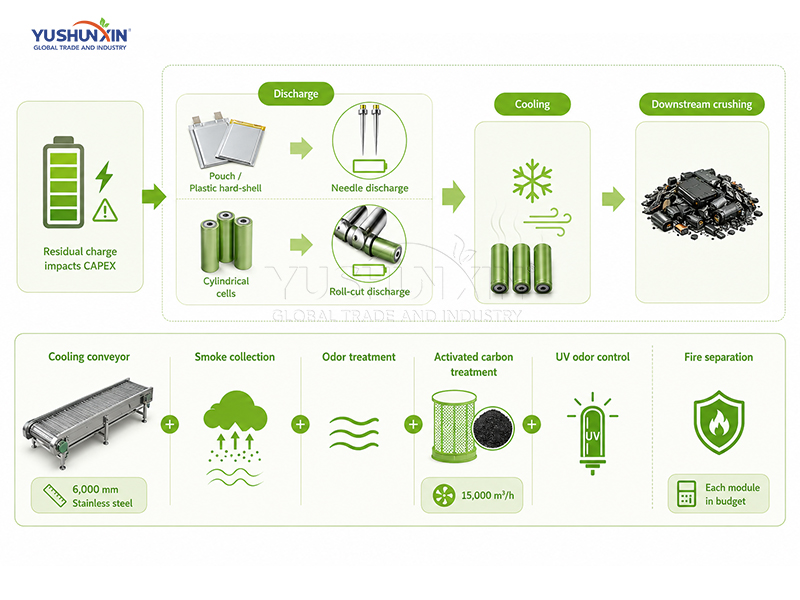
This route suits buyers with shredding, smelting, or refining partners. The system covers sorting, feeding, discharge, cooling, primary crushing, and gas treatment. Pouch and plastic-shell cells can use needle discharge. Cylindrical cells can use roll-cut discharge. These options reduce fire risk and lower first-stage CAPEX. They also preserve interfaces for later upgrades.
Route Two: Saleable Black Mass Production
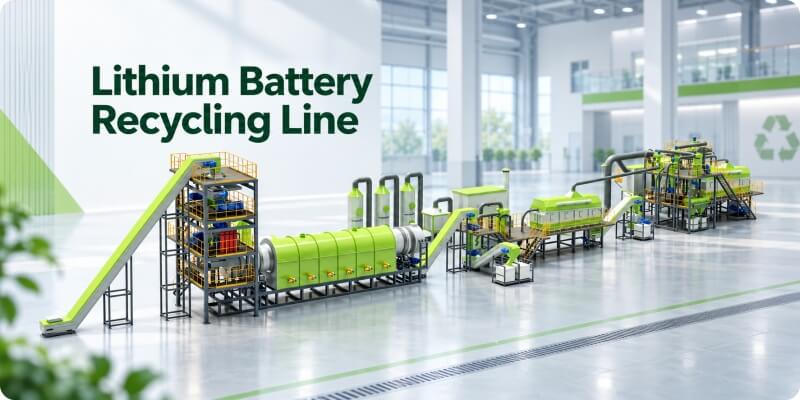
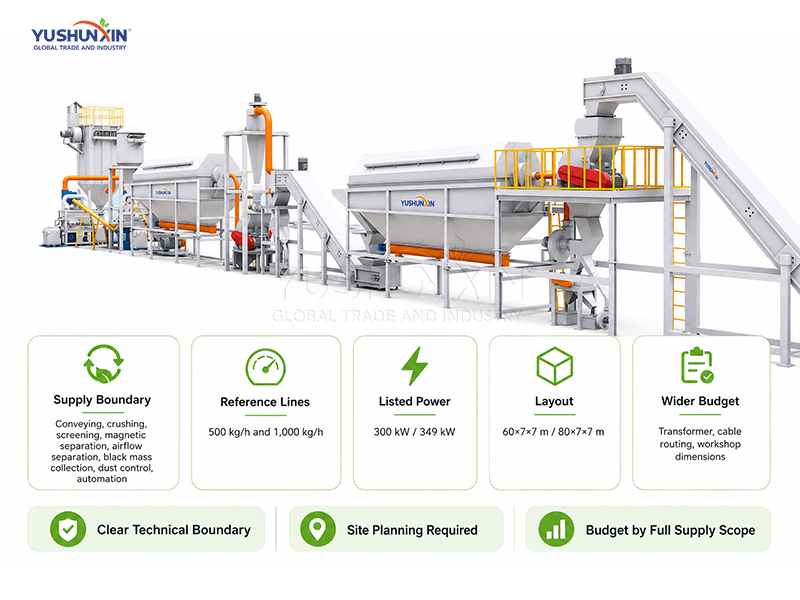
This route suits recyclers selling black mass, copper, aluminum, and iron fractions. The line combines discharge, staged crushing, magnetic separation, airflow separation, screening, dust collection, and packing. Yushunxin uses 500 kg/h and 1,000 kg/h lines as reference configurations. Their listed power reaches 300 kW and 349 kW. However, final power depends on feedstock and product targets. This route receives the largest budget share because product quality drives revenue.
Route Three: Expandable Contract-Grade Recovery
This route suits large operators with supply contracts and defined product specifications. The budget can add finer separation, recirculation, weighing, sampling, product silos, data logging, and packing. It can also reserve space for hydrometallurgical or pyrometallurgical interfaces. Therefore, the project can expand without replacing the core line. You can first fund the revenue-producing core section. Then, you can add modules after product contracts become stable.
How Do you Budget the Full Lithium Battery Recycling Project Boundary?
A lithium battery recycling quotation rarely covers every cost required for commercial production. Upstream preparation, site utilities, and product handling can change total investment significantly. Therefore, buyers should divide the project into clear budget boundaries before approving equipment.
Budget the Front End From Battery Condition
Battery condition controls the front-end budget. Loose cells may require sorting, residual-charge testing, discharge, cooling, and controlled feeding. However, battery modules and packs need dismantling stations, lifting equipment, fireproof storage, and larger buffer areas. Pouch and hard-shell cells can use needle discharge. Meanwhile, cylindrical cells may require roll-cut discharge and dedicated cooling. These differences change equipment quantity, labor demand, ventilation capacity, and required floor area.
Include Product Delivery and Site-Ready Costs
Downstream readiness adds another investment layer. Buyers may need black mass packaging, copper storage, aluminum storage, sampling rooms, and product testing. The site may also require refining interfaces, wastewater treatment, forklifts, foundations, fire systems, and spare parts. Moreover, freight, import duties, installation, commissioning, and working capital can widen the final project cost.
Price the Recovery Line by Supply Boundary
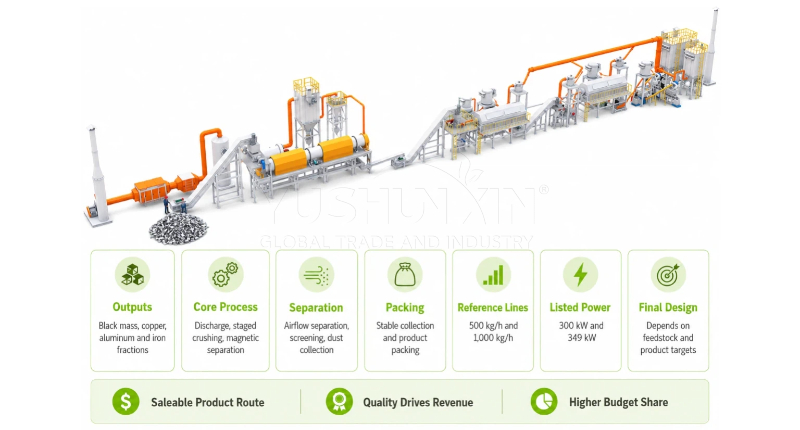
Core quotation should list each machine and technical boundary. Yushunxin lines include conveying, crushing, screening, separation, black mass collection, dust control and automation for 500 kg/h and 1,000 kg/h configurations.
Get your Solution!The lithium battery recycling machine price should not be defined by equipment capacity alone. Feedstock characteristics, product targets, operating conditions, safety requirements, and future expansion plans all influence the final investment. Yushunxin helps customers build a practical budget by matching discharge, crushing, separation, dust control, and optional refining modules with real project needs. This approach helps investors control initial costs while creating a scalable recycling solution for long-term growth.
”
From Your Needs
to Real Impact


