













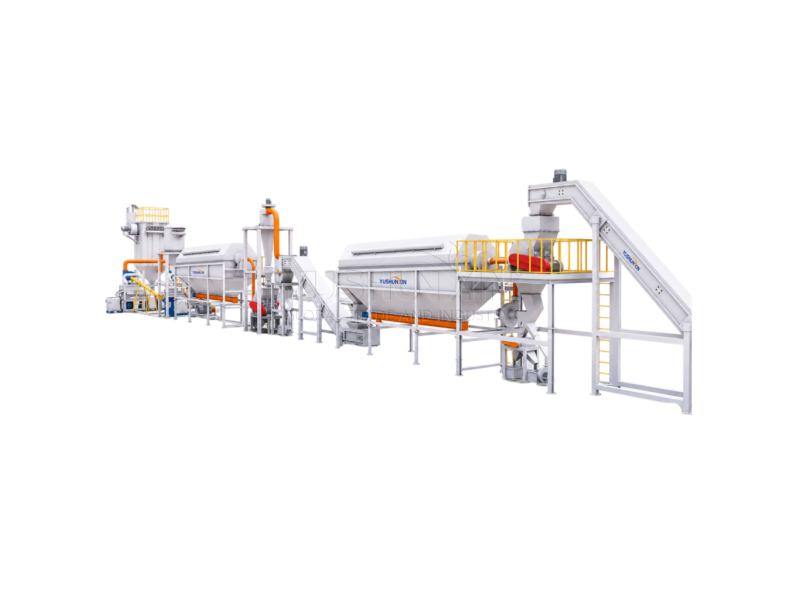


Growing battery retirements are increasing demand for cleaner black mass and higher-value metal recovery. Material liberation directly affects black mass purity and copper foil and aluminum foil quality. Crushing must detach electrode coatings while limiting excessive fines and metal loss. This article examines crushing stages, particle-size control, screening, airflow separation, magnetic separation, and commercial performance validation.
How Does a Liberation Circuit Match Black Mass and Metal Product Targets?
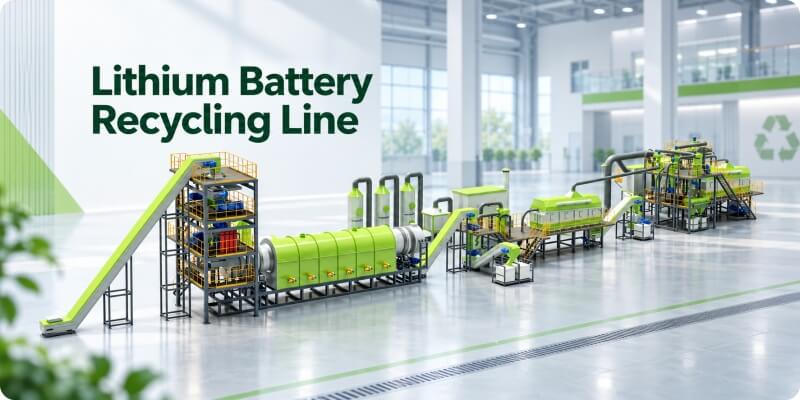
01 · Liberation CircuitMaterial liberation should follow product specifications, not the smallest achievable particle size. The circuit must release coatings while protecting copper foil, aluminum foil, steel, and plastics. Therefore, engineers should define impurity limits before selecting crushers, screens, and separators. Yushunxin reference lines process 500 kg/h or 1,000 kg/h. Their listed powers reach 300 kW and 349 kW. Both configurations combine physical crushing, airflow separation, and vibrating screening. They recover black powder, copper, aluminum, and iron fractions.
Product Specifications Set Liberation Target
Product Specifications define the Liberation Target for each stream. Black mass, copper, aluminum, steel and plastic need different purity limits and equipment responses.
Controlled Liberation Prevents Value Loss
Controlled Liberation avoids over-crushing and metal loss. Staged crushing, screening and separation improve black mass quality while reducing copper, aluminum and dust contamination.
Material Balance Confirms Performance
Material Balance tracks black mass, copper, aluminum, steel, plastics and losses. Recovery, purity and recirculation data verify liberation performance after testing.
How Should Feedstock Data Define the Crushing Solution?
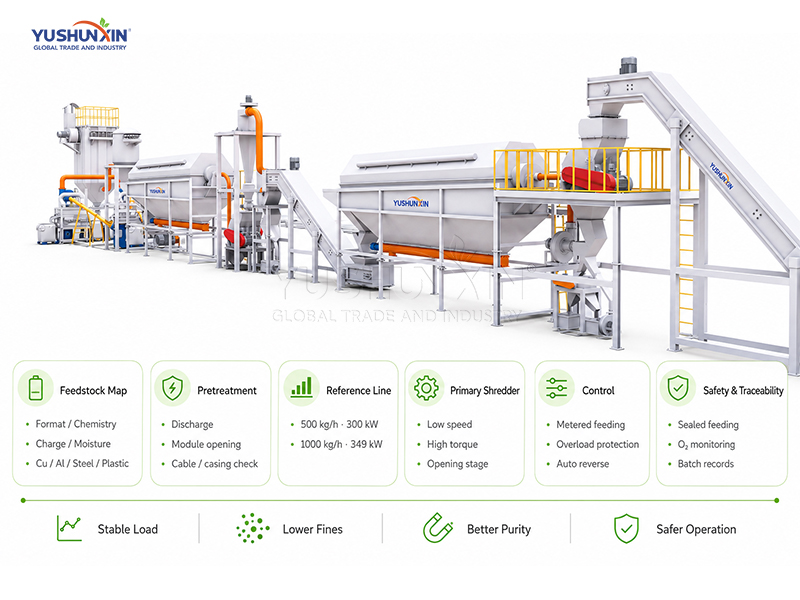
02 · Crushing SolutionA crushing line should start with a feedstock map, not a fixed machine list. Battery format, chemistry, charge level, moisture, and casing structure change the required pretreatment. Therefore, two projects with equal capacity may need different shredders, screens, and safety controls. Yushunxin reference lines cover 500 kg/h at 300 kW and 1,000 kg/h at 349 kW. However, final power and layout should follow representative material tests.
Map the Feedstock Before Selecting the Crusher
Set the Crushing Boundary Through Controlled Pretreatment
Match Primary Shredder Settings to Battery Structure
How Does a Staged Liberation Circuit Protect Copper and Aluminum Foils?
03 · Liberation CircuitIndustrial material liberation needs several controlled stages. A single aggressive crusher creates excess fines and lowers metal value. Yushunxin lines combine physical crushing, airflow separation, and vibrating screening. Reference capacities include 500 kg/h and 1,000 kg/h.
Primary Shearing
Opens Cells Safely
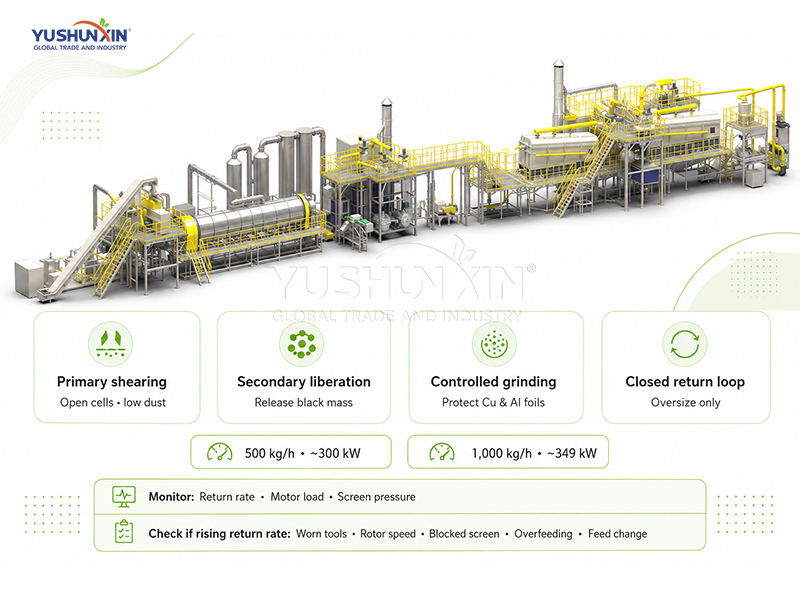
Primary Shearing opens battery structures while reducing heat and metal powder. Low-speed control helps expose internal layers without excessive foil damage.
Secondary Liberation
Releases Electrode Coatings
Secondary Liberation separates electrode coatings from copper and aluminum foil. Proper speed, feed rate and residence time improve black mass quality.
Match Equipment
With Liberation Force
Liberation Force should match battery structure and output targets. Shredding, crushing and milling require different forces to avoid metal pulverization and contamination.
Closed Return Loop
Improves Recovery
Closed Return Loop sends unliberated oversize back for further treatment. It reduces over-grinding, protects foils and stabilizes downstream separation.
How Does a Screening Circuit Route Black Mass and Metal Fractions?
04 · Screening Circuit
Screening should control the liberation circuit, rather than simply classify finished materials. Each deck should route fines, metal fractions, and oversized pieces toward different stages. Yushunxin’s reference lines combine crushing, airflow separation, and vibrating screening. They offer processing capacities of 500 kg/h and 1,000 kg/h.
Tested Cut Points Build Recovery Route
Tested Cut Points define particle routing and product quality. Material testing helps set screening sizes for black mass, copper, aluminum and plastic recovery.
Multi-Deck Screening Stabilizes Separation
Multi-Deck Screening creates stable particle ranges for downstream separation. Different decks reduce interference and improve black mass and metal recovery efficiency.
Anti-Blinding Design Protects Material Balance
Anti-Blinding Design prevents blockage from wet powder, films and fine wires. Stable screening improves recovery, reduces re-crushing and protects metal fractions.
How Does a Separation Circuit Route Each Liberated Battery Fraction?
05 · Liberated Battery FractionSuccessful separation starts with material behavior, not with a long equipment list. Engineers should narrow particle sizes before applying magnetic, airflow, gravity, or electrostatic forces. This sequence protects black mass purity and improves copper and aluminum quality. Yushunxin reference lines combine crushing, airflow separation, and vibrating screening. Available configurations cover 500 kg/h and 1,000 kg/h. Their reference power reaches 300 kW and 349 kW.
Remove Ferrous Contamination Before Fine Separation
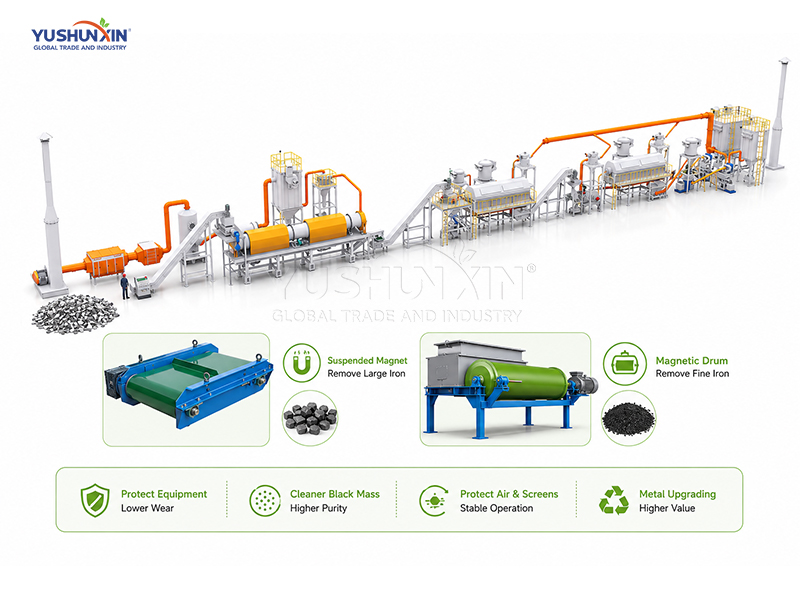
Remove Ferrous Contamination before fine separation. Magnetic drums and suspended magnets reduce iron carryover and protect downstream screening and upgrading equipment.
Use Controlled Airflow For Material Separation
Upgrade Copper And Aluminum Through Gravity Separation
Add Electrostatic Polishing For Higher Purity
Recover Black Mass Through Enclosed Transfer
Match Separation Force With Material Characteristics
How Should a Commercial Line Verify Liberation Performance Before Acceptance?
06 · Commercial LineCommercial acceptance must verify product quality and stable output. Engineers should test the complete line under continuous load. Peak crusher capacity alone cannot prove project performance.
Product Testing Confirms Liberation Quality
Product Testing evaluates Liberation Quality through residual coating, metal contamination, black mass carryover and ferrous content. These results verify separation performance.
Continuous Operation Proves Rated Capacity
Continuous Operation should verify throughput, product output, recirculation ratio and downtime. Actual capacity depends on battery type and impurity level.
PLC Controls And Feed Trials Confirm Stability
PLC Controls monitor current, temperature, oxygen, airflow and dust pressure. Feed Trials with different batteries verify stable operation and final product quality.
Summary
Material liberation determines black mass purity, metal recovery, and overall line stability. Yushunxin can design a complete lithium battery recycling solution around your battery type, capacity, and product targets. Our scope can cover discharge, crushing, screening, airflow separation, magnetic separation, dust collection, and PLC control. If you want to get more details for lithium battery recycling, please contact us.
From Your Needs
to Real Impact


