



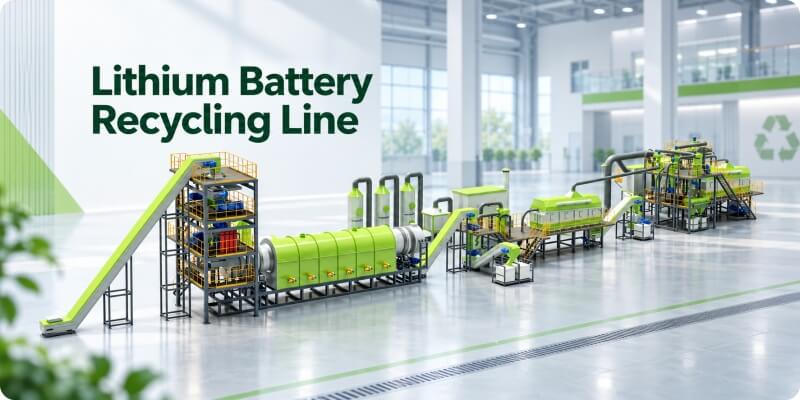










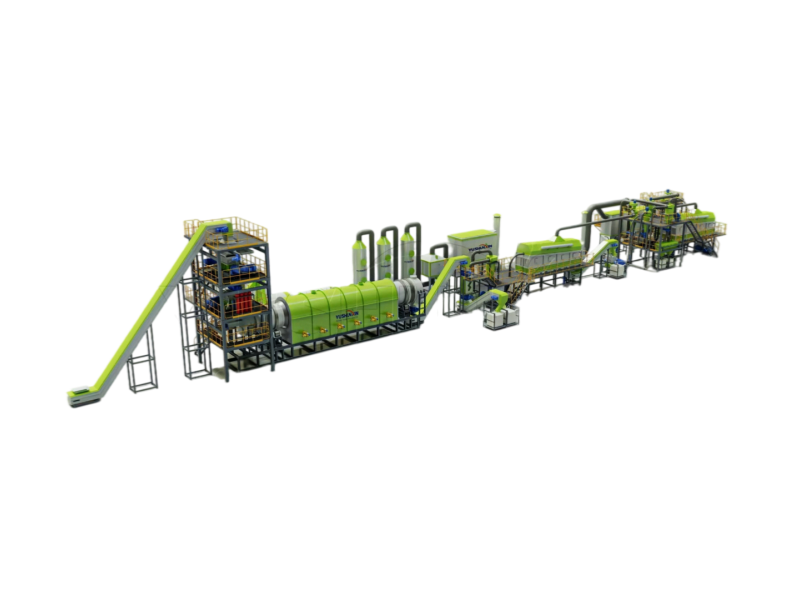


Lithium battery recycling projects need a route that protects safety and product value together. The right plant should match battery type, discharge method, crushing depth, thermal treatment, separation accuracy, and black mass sales target. For industrial buyers, capacity alone cannot define the solution. A workable line must reduce fire risk, control copper and aluminum contamination, recover black mass efficiently, and prepare sellable metal fractions for downstream buyers.
How Should Lithium Battery Intake Define the Recycling Line?
01 · Definition
A lithium battery recycling plant should first define the intake route. This step decides the discharge method, crushing depth, fire-control design, separation process, and black mass quality. Industrial buyers often receive mixed batteries, yet each stream creates different risks. Therefore, the solution should classify feedstock before equipment selection.
Separate Production Scrap From Retired Batteries
Production scrap usually comes from battery factories. It has a clearer source, lower impurity level, and more stable composition. Therefore, it suits continuous feeding and predictable black mass recovery. Retired batteries need stricter control. They may contain different shapes, unknown charge levels, damaged shells, mixed metals, and moisture. So the plant should add sorting, inspection, and isolation before crushing.
Treat EV Batteries as an Independent Project Route
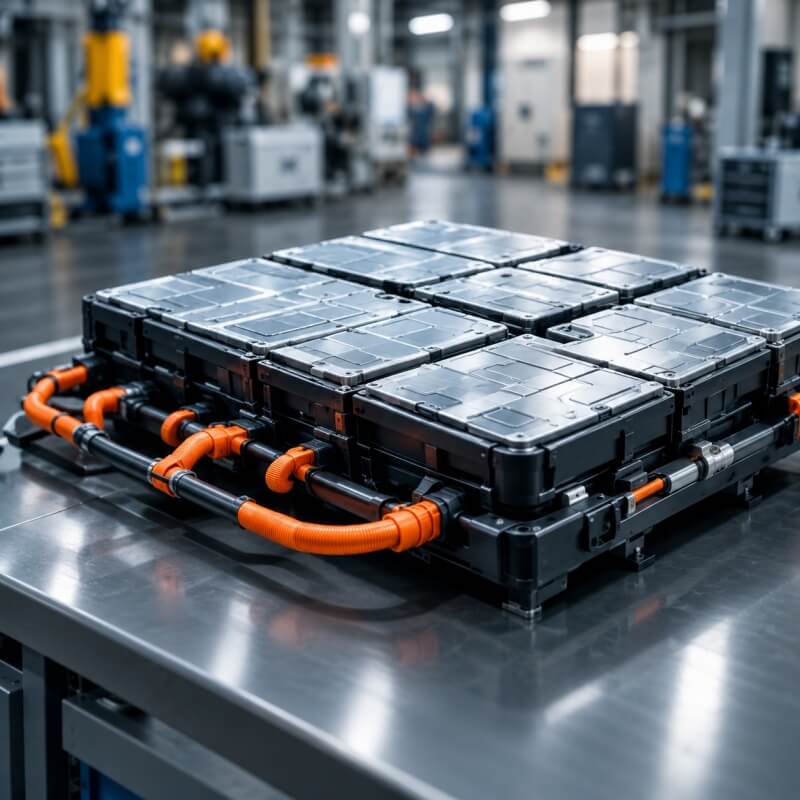
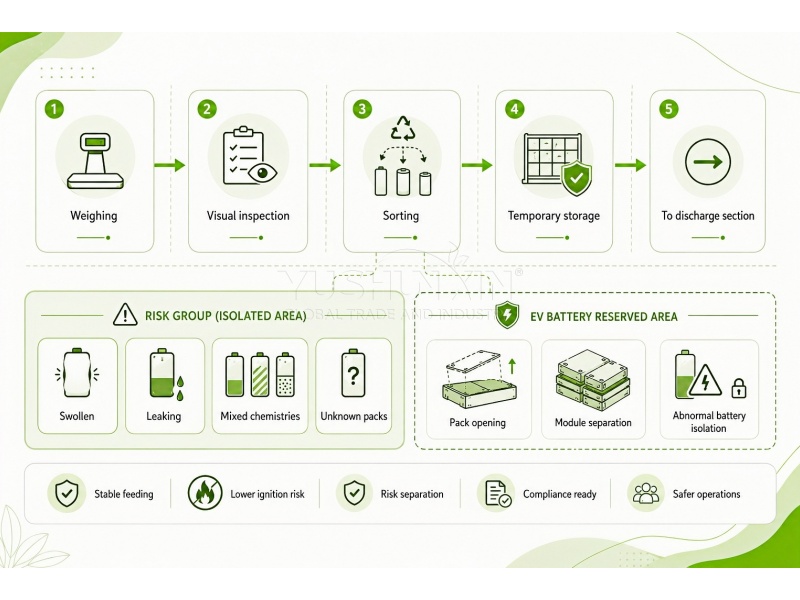
EV batteries should not enter the same route as loose cells. They often require pack opening, module separation, cable removal, SOC confirmation, and abnormal battery isolation. This front-end work reduces thermal runaway risk. It also protects the main crushing line from unstable feeding. For high-value projects, EV battery recycling should include a dedicated dismantling area before the black mass recovery line.
How Can the Safety Intake System Control Lithium Battery Risk Before Crushing
02 · SafeAfter crushing, the grinding mill processes the material to 10-80 mesh. This particle range prepares the material for copper recovery and silicon powder separation. Then, the gravity separator separates copper from silicon powder and plastic powder. After that, the electrostatic separator separates silicon powder from plastic powder. This route helps buyers create cleaner output streams. Copper can enter the metal recycling market. Silicon powder can move toward further refining or reuse channels. Plastic powder can be collected separately for disposal or downstream treatment. As a result, the plant does not only “recycle panels.” It builds separated material flows for commercial use.
Build a Risk-Separated Receiving Area
Before batteries enter the main line, the project should set a receiving area for weighing, visual inspection, sorting, and temporary storage. Operators should separate swollen batteries, leaking batteries, mixed chemistries, and unknown packs. Then, the system can send stable materials into the discharge section. This layout reduces mixed feeding and protects the crusher from sudden ignition. For EV battery projects, this area should also reserve space for pack opening, module separation, and abnormal battery isolation.
Get a free quote!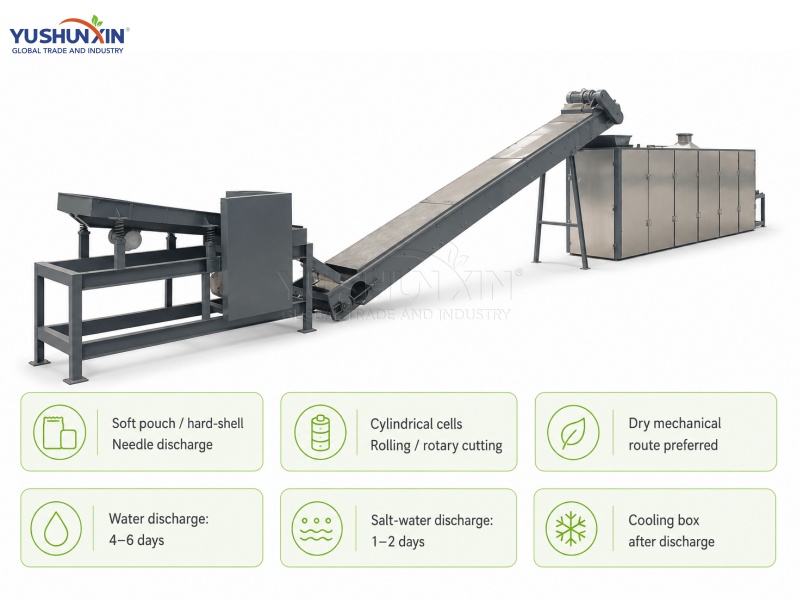
Match Discharge Design With Battery Shape
Different battery shapes need different discharge methods. Soft pouch cells and plastic hard-shell cells usually suit needle discharge. Cylindrical cells usually suit rolling cutting or rotary cutting discharge. Water discharge may take 4–6 days, while salt-water discharge may take 1–2 days. However, both methods can create odor, saturated liquid, and wastewater. Therefore, industrial projects should prefer a dry mechanical discharge route when capacity and environmental control matter. After discharge, batteries should enter a cooling box before the next process.
Get a free quote!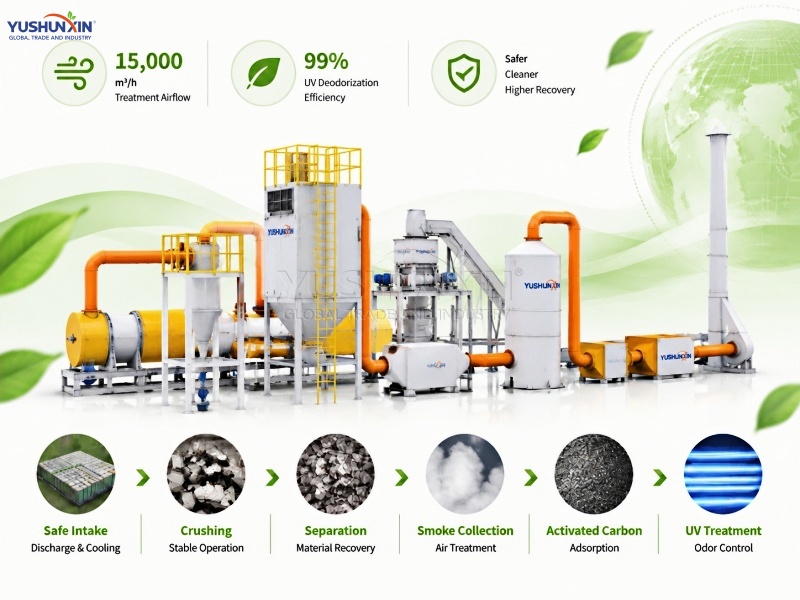
Set Safety Capacity Before Crusher Capacity
The crusher should not define the whole line speed alone. The safety intake system must first reach stable discharge, cooling, and smoke collection. Then, crushing and separation can run at full load. For smoke and odor control, the front-end area can connect with activated carbon adsorption and UV treatment. A reference treatment airflow can reach 15,000 m³/h, and UV deodorization can reach about 99%. This setup helps the plant protect workers, equipment, and black mass recovery.
Get a free quote!How Can the Lithium Battery Crushing System Protect Black Mass Value?
03 · Crushing System
High-value lithium battery recycling projects should design crushing around black mass quality. The goal is not only to break batteries. It is to release active materials while keeping copper, aluminum, iron, and separator films away from the powder stream. Therefore, the crushing route must balance liberation, safety, particle size, and downstream refining cost. For a 500–1000 kg/h industrial line, small changes in crushing depth can affect black mass purity, dust recovery, and metal fraction value.
Use Screening to Stabilize Separation
Screening should stand between crushing and final separation. It controls particle size before airflow separation, magnetic separation, and gravity separation. As a result, each separator receives a more stable material layer. Large pieces can return for secondary crushing. Fine powder can enter dust recovery and black mass collection. This closed loop reduces material loss and avoids unstable product quality.
Treat Black Mass as the Main Product
Black mass should guide the whole process route. Copper, aluminum, iron, and plastic separator films still matter. However, they mainly serve black mass quality control. A strong solution should define black mass recovery rate, Cu/Al impurity level, moisture control, and packaging method before equipment selection. Then, every crushing and separation step supports one commercial goal: producing sellable black mass with fewer refining risks.
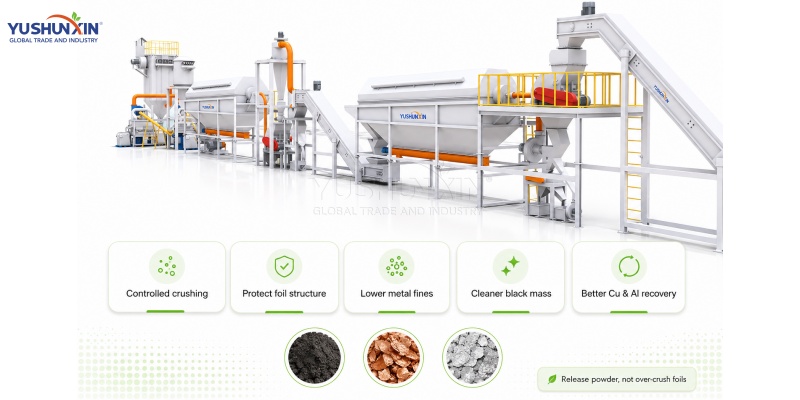
Avoid Over-Crushing Copper and Aluminum Foils
Copper and aluminum foils should stay as larger fractions where possible. If the crusher cuts them too fine, these metal fines mix with black mass. Then, downstream buyers may face higher impurity removal costs. So the plant should not chase the smallest particle size. Instead, it should choose a crushing depth that releases electrode powder without destroying foil structure. This approach protects black mass value and improves metal recovery.
Get your Solution!Should the Solution Add Thermal Treatment Before Fine Separation?
04 · PyrolysisThermal treatment should not appear as an isolated furnace choice. It should solve a product-quality problem. In lithium battery recycling, electrode binders, electrolyte residue, separator films, and mixed organics can reduce black mass purity. They can also make copper and aluminum foils harder to separate. Therefore, the plant should add thermal treatment when mechanical crushing alone cannot release active materials cleanly. For stable manufacturing scrap, a dry mechanical route may work well. However, mixed batteries, high binder residue, or strict black mass specifications often need thermal assistance before final screening and separation.
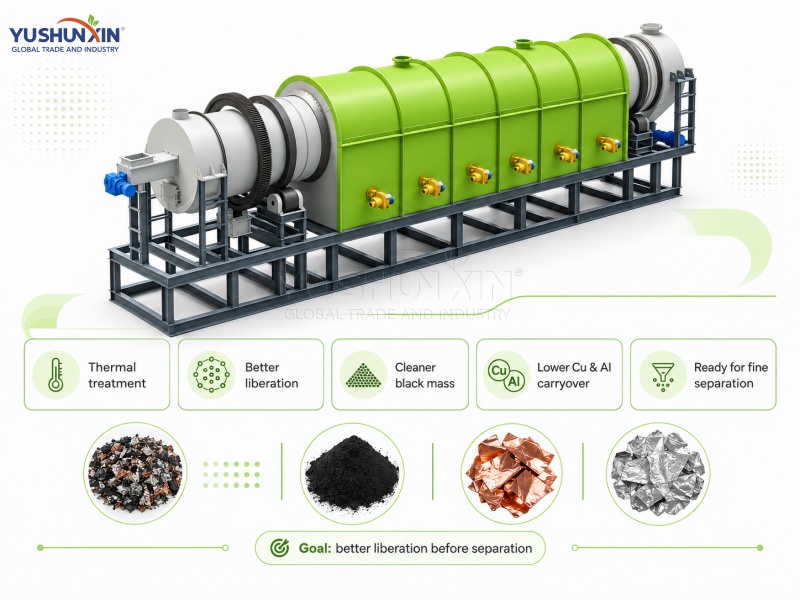
Use Thermal Treatment to Improve Electrode Liberation
Control Organics Before Product Refining
Compare the Route Before Selecting the Line
How Does Environmental Control Recover More Black Mass?
05 · Environment
Environmental control should protect both compliance and product value. In a lithium battery recycling plant, fine black mass can escape during crushing, screening, transfer, and packaging. Therefore, the solution should combine sealed conveying, negative pressure, pulse dust collection, smoke treatment, and controlled powder return. This design keeps the workshop cleaner. More importantly, it helps recover fine active material instead of losing it as dust.
Environmental Control Protects
Black Mass Value
A lithium battery recycling line needs environmental control to reduce powder loss. Sealed conveying, negative pressure, and dust collection help capture fine black mass and keep the workshop cleaner.
Negative Pressure
Improves Powder Recovery
Crushing and screening areas should operate under negative pressure. Dust collectors capture fine particles before they spread, balancing powder recovery, airflow control, and production safety.
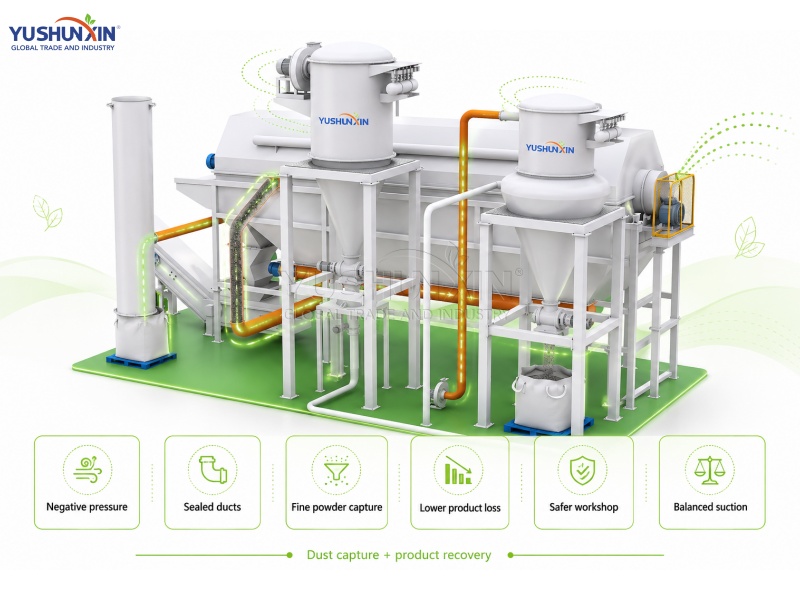
Dust Collection
Connects With Packaging
Collected powder should be tested before returning to black mass production. Proper classification improves material traceability, reduces loss, and supports stable product quality.
Gas Treatment
Supports Safe Operation
Battery discharge and processing may create smoke and odor. Dust removal, activated carbon, and odor treatment systems help control emissions and maintain a stable working environment.
How Can Product Strategy Shape the Final Lithium Battery Recycling Line?
06 · Product
A lithium battery recycling plant should design backward from product sales. Black mass, copper, aluminum, iron, and separator films need different buyers. Therefore, the line must control purity, moisture, packaging, and records from the beginning. At 1000 kg/h, a 1% handling loss equals 10 kg/h. Over 24 hours, this becomes 240 kg of material flow. So product planning directly affects daily revenue.
MASS TARGETS
Define Black Mass Targets Before Line Configuration
Black mass usually carries the main project value. So buyers should define moisture, copper content, aluminum content, particle range, and packaging method first. Then the plant can decide crushing depth, screening stages, negative-pressure collection, and dust return method. This avoids selling black mass with high metal contamination. It also gives downstream processors more confidence during price negotiation.
METAL FRACTIONS
Separate Metal Fractions for Easier Sales
Copper, aluminum, and iron should leave the line as separate streams. Mixed metals often receive a lower price because buyers need extra sorting. Therefore, the plant should arrange magnetic separation, airflow separation, screening, and optional gravity separation around product outlets. Separate collection also simplifies storage, weighing, and loading. It helps the operator sell to different metal recyclers instead of one low-value mixed-material buyer.
BATCH
RECORDS
Use Batch Records to Support Repeat Orders
High-value buyers care about traceability, not only product appearance. Each black mass batch should record feedstock source, battery type, processing date, input weight, product weight, and basic test results. These records support repeat sales and reduce price disputes. They also help operators compare different feedstock suppliers. When one source causes higher impurities, the plant can adjust pretreatment or purchasing price quickly.
Summary
A lithium battery recycling plant must balance safety, feedstock control, black mass quality, separation accuracy, and product sales. Therefore, buyers should not choose a line only by hourly capacity. They should first confirm battery type, discharge route, crushing depth, environmental requirements, and downstream buyer standards. Yushunxin can provide complete lithium battery recycling plant solutions for 500 kg/h and 1000 kg/h projects. We can also configure front-end discharge, controlled crushing, thermal treatment, fine separation, dust recovery, and black mass packaging systems. For deeper project planning, we can also provide you with black mass recovery for lithium battery recycling, EV battery recycling plant and ESS battery recycling line.
From Your Needs
to Real Impact


