
















As industrial lithium battery recycling expands, black mass loss becomes a line-design issue, not only a final collection problem. Mixed feed can create uneven crushing performance. Poor liberation leaves active material on copper and aluminum foils, while over-crushing produces ultrafines. Incorrect screening then sends black mass into metal or reject streams. Excessive airflow can also pull saleable powder into ducts and filters. This FAQ explains how equipment configuration and process control reduce these losses across industrial crushing and sorting lines.
How Should a Recycling Line Condition Mixed Battery Feed Before Liberation?
Mixed battery feed should not enter one crusher as an undefined blend. Cylindrical, pouch, prismatic, module, and electrode scrap structures open under different forces. Therefore, one fixed gap and speed cannot release every coating evenly. High-value projects need controlled feed routes before primary crushing.
Build Dedicated Feed Paths For Battery Structure
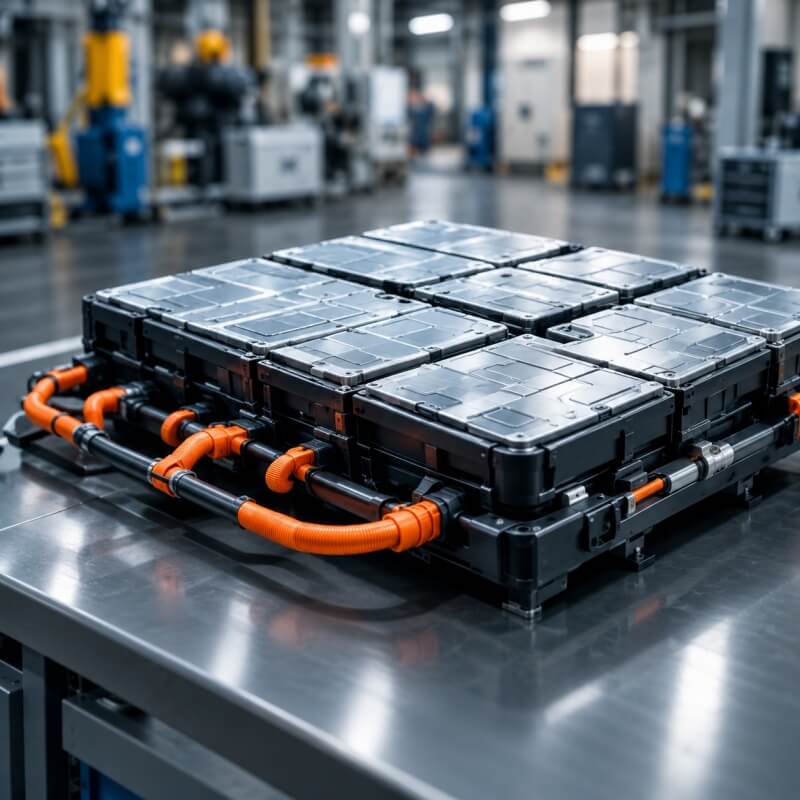
Dedicated Feed Paths match Battery Structure and crushing requirements. Cylindrical, pouch, prismatic cells and modules need different pretreatment to control metal contamination and particle size.
Keep Crusher Within Controlled Load Window
Controlled Load Window maintains stable feeding and crushing. Buffer hoppers, variable-speed feeders and monitoring systems reduce overload, improve liberation and protect black mass quality.
| Feed Type | Main Crushing Challenge | Recommended Line Response |
| Cylindrical cells | Steel shells resist opening | Add shell separation and controlled primary crushing |
| Pouch cells | Flexible packaging folds during feeding | Use uniform feeding and suitable blade spacing |
| Prismatic cells | Thick housings create high impact loads | Apply controlled dismantling before crushing |
| Electrode scrap | Material already has an open structure | Bypass unnecessary coarse crushing |
| Battery modules | Frames and connectors disturb the crusher | Add module dismantling and foreign-object removal |
How Can Controlled Crushing Protect Black Mass Recovery?
Black mass recovery depends on a stable liberation window. Coarse material retains active powder on metal foils. However, excessive crushing creates ultrafines and metal contamination. Therefore, the line should release coatings without destroying valuable copper and aluminum fractions.
Staged Crushing Releases More Black Mass
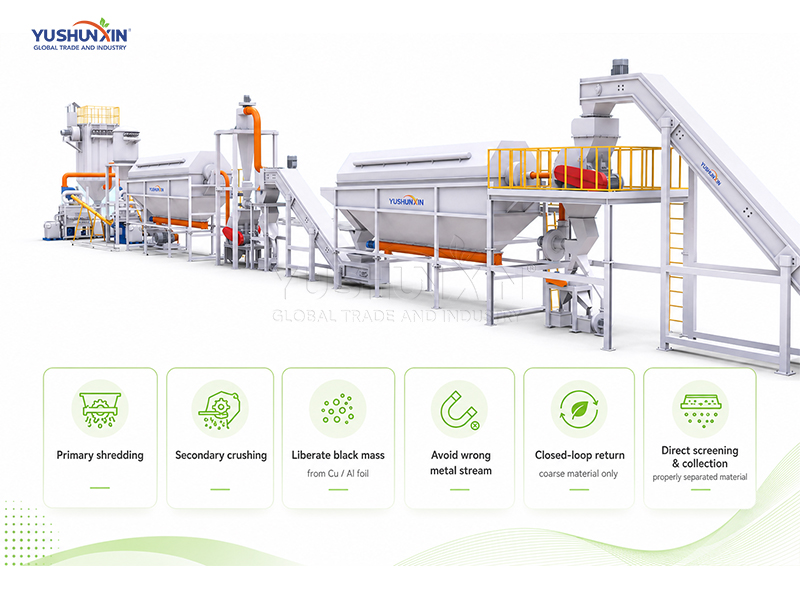
Primary shredding opens battery structures. Then, secondary crushing separates active material from copper and aluminum foils. Insufficient crushing leaves black mass attached to metal fragments. These fragments cannot pass through the powder screen. Therefore, they enter copper or aluminum products. The black mass has not disappeared. It has moved into the wrong product stream. A closed-loop system should return only coarse, unliberated material. Meanwhile, properly separated material should enter screening and collection directly.
Excessive Crushing Reduces Saleable Powder
More crushing does not always produce more saleable black mass. High speed and narrow clearances create excessive ultrafines. Meanwhile, copper and aluminum foils break into small particles. These metal fines increase black mass contamination. Ultrafines can also enter ducts and dust filters. Therefore, the line should use variable speed, adjustable clearances, replaceable screens, and controlled coarse return. Final acceptance should compare particle size, foil residue, metal contamination, and ultrafine content. These results confirm whether the crushing circuit protects black mass recovery.
How Does the Screening System Secure Black Mass Recovery?
Screening determines where released black mass finally goes. If apertures are too large, metal fines enter the powder stream. If apertures are too small, qualified powder returns with coarse material. Therefore, the line needs tested apertures, stable loading, and sealed collection.
Keep the Material Bed Thin and the Screen Surface Open
Even the correct aperture fails when the material bed becomes too deep. High feed peaks bury fine powder beneath foil and casing fragments. Therefore, black mass cannot reach the screen surface in time. Electrolyte residues can form sticky agglomerates. Plastic separator film can also cover openings and reduce effective area. A distribution feeder and variable-speed dosing system keep the material bed uniform. Meanwhile, cleaning balls or automatic cleaners reduce screen blinding. Pressure, motor-load, and vibration trends can reveal declining screening performance. Large access doors then shorten cleaning and screen replacement.
Why Can a Line Meet Capacity While Still Losing Black Mass
Rated throughput measures material flow, not separation quality. A heavily loaded screen can still pass the required tonnage. However, it may send black mass into metal streams or recirculation. Therefore, final acceptance must compare mass balance and product purity during continuous operation.
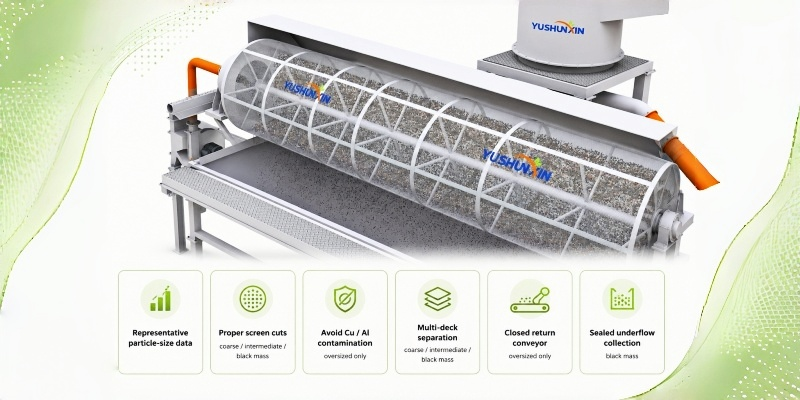
Screen selection Follows Particle-Size Data
Screen selection should follow representative particle-size data. Proper aperture design reduces copper and aluminum contamination while improving black mass recovery.
Get your Solution!How Should the Dust Recovery System Protect Saleable Black Mass?
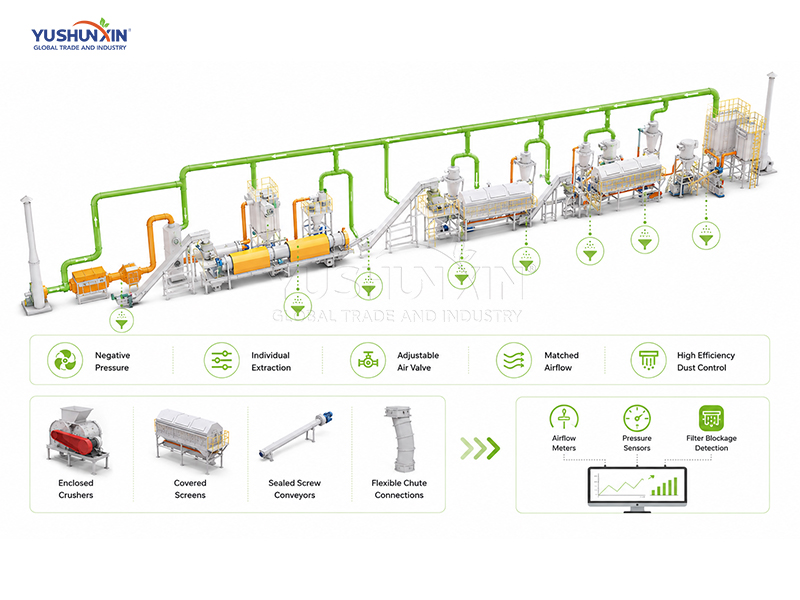
A dust system must control emissions without removing saleable black mass. Excessive suction pulls released powder from crushers, screens, and transfer points. Open drops increase entrainment, while narrow ducts raise air velocity. Therefore, the line needs sealed transport, controlled suction, and measurable powder recovery.
Control Suction At Every Dust Source
Separate Collected Dust Before Returning Product
Protect Complete Dust Route With Safety Control
Black mass loss usually develops across the complete line, rather than inside one crusher. Mixed battery feed destabilizes crushing and changes liberation performance. Incorrect particle size leaves active material attached or creates excessive ultrafines. Poor screening then sends black mass into metal or reject streams. Meanwhile, uncontrolled suction can pull saleable powder into ducts and filters. Therefore, buyers should compare the complete crushing, screening, conveying, dust collection, and powder recovery route. Yushunxin can provide a complete lithium battery recycling solution around your actual feedstock. We configure the line according to battery format, chemistry, feed ratio, hourly capacity, and target black mass purity. We also consider copper and aluminum limits, local safety rules, and environmental requirements.
”
From Your Needs
to Real Impact


