

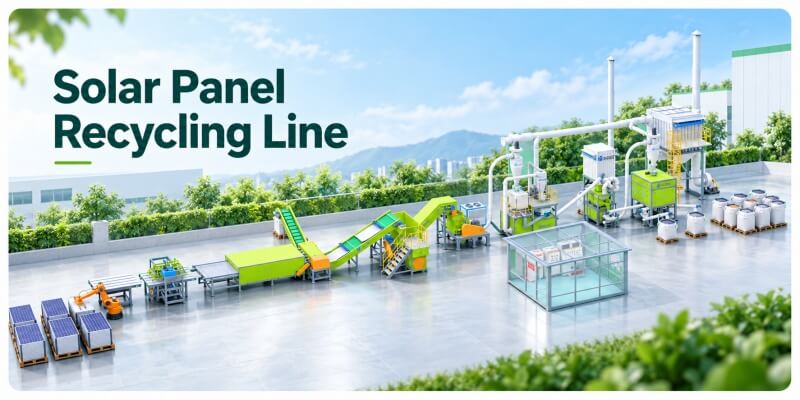











On May 28, 2026, a French recycler sent us an inquiry about solar panel silver recovery. The customer was not seeking a standalone frame-removal machine. Instead, it required an industrial line for recovering glass, silicon, copper, and silver-rich materials. It also asked about silver refining, wastewater control, CE documentation, and French site requirements. According to his requirements, we recommend him a complete solar panel recycling plant with silver recovery. The following are the specific details of the proposed equipment, product targets, and acceptance plan.
How Did Feedstock Verification Build the French Silver-Recovery Solution?
The French customer first asked how much silver the project could recover each day. However, daily output depends on module structure, silver content, and concentrate grade. Therefore, Yushunxin started with feedstock verification, not an unsupported silver promise.
Module Structure Sets Pretreatment Route
Module Structure determines the Pretreatment Route. Single-glass, double-glass and broken modules require different glass removal, thermal delamination and separation methods.
Capacity Figures Prevent Silver Estimate Errors
Capacity Figures separate panel input, silver-rich concentrate and refining output. Silver Estimate should follow testing, material balance and actual recovery rates.
Capacity Matching Defines Yushunxin Configuration
Capacity Matching connects feedstock volume with equipment models. Yushunxin selects YSX-1000, YSX-8000 or YSX-16000 based on project scale and expansion needs.
How Did this Solution Turn Silver-Rich Material Into a Saleable Product?
The customer did not want equipment that only separated bulk materials. It wanted a controlled route from retired panels to saleable silver. Therefore, Yushunxin designed each stage around silver grade, recovery, and final product quality. The proposal also separated thermal treatment from chemical refining.
Front-End Separation Preserved the Silver-Bearing Cell Material
The line first removed aluminum frames and junction boxes. This step recovered aluminum, copper, and plastic before thermal treatment. Next, thermal delamination decomposed EVA or POE and released the laminated cell material. The cooling system then stabilized the output before screening. Screening removed glass and larger copper ribbons. Finally, grinding and separation concentrated silver-bearing cell powder for wet processing.
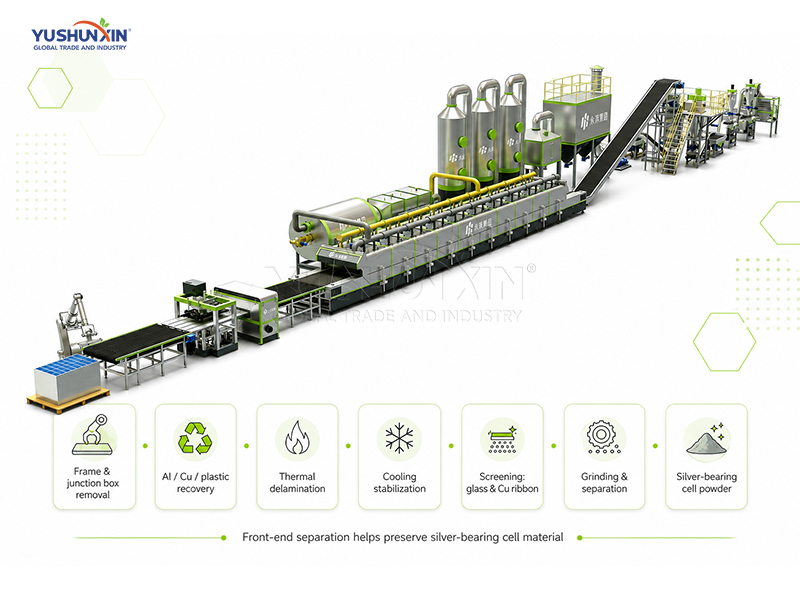
The customer asked, “Can the pyrolysis furnace produce silver directly?” It cannot produce silver ingots. Instead, it releases and concentrates the silver-bearing cell material. Therefore, the refining section must follow thermal delamination and physical separation. For mixed panels, YSX-8000 and YSX-16000 offer reference capacities of 8 and 16 tonnes daily. Feedstock testing must confirm the final capacity.
Wet Leaching Converted Concentrate Into a Defined Rough-Silver Product
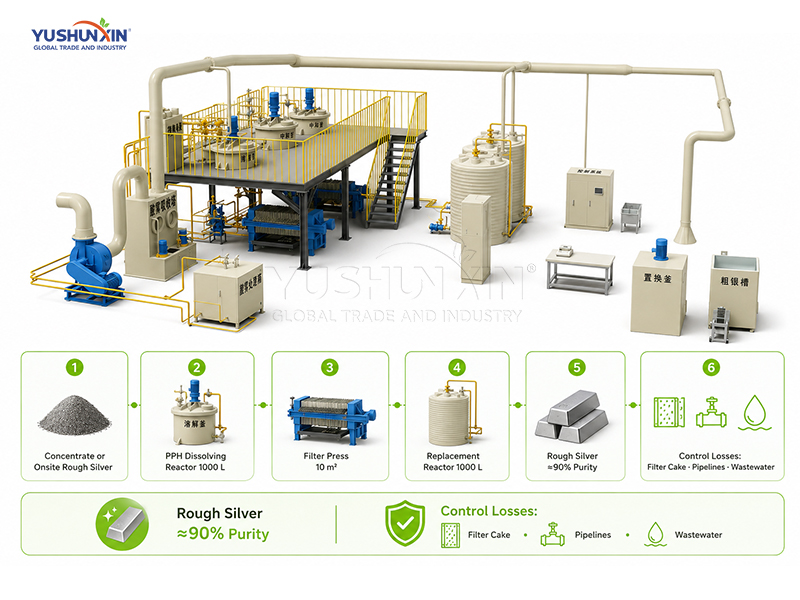
Yushunxin asked whether the customer would sell concentrate or produce rough silver onsite. This decision affected reactor capacity, operating skills, and treatment costs. For onsite recovery, the concentrate enters a 1,000-liter PPH dissolving reactor. Controlled reagent dosing then transfers silver into the liquid phase. Next, a 10-square-meter filter press removes silicon and insoluble residues. Diaphragm pumps transfer the solution into a 1,000-liter replacement reactor. The replacement process then produces rough silver for further refining. The reference process targets about 90% purity after rough recovery. However, the project must also measure losses in filter cake, pipelines, and wastewater.
Rough silver then enters electrolysis, drying, melting, and ingot casting. The reference refining module produces 30 kilograms daily under its stated operating basis. It also includes a 45-kilowatt melting furnace and a 15-kilogram ingot mould. However, the contract must define the final purity and assay method. Meanwhile, wastewater enters neutralization, filtration, and activated-carbon adsorption. Acid fumes enter a dedicated collection and scrubbing route. These systems reduce operational risks but cannot replace French permits. Yushunxin can supply pretreatment, delamination, sorting, rough recovery, electrorefining, and treatment equipment. The customer must arrange chemical permits, hazardous storage, laboratory testing, fire protection, and occupational controls. This division keeps equipment supply separate from local legal responsibility.
How Can the Solar Panel Silver Recovery Project Prove the Line Is Ready for Approval?
The equipment proposal must also cover traceability, site compliance, and measurable acceptance results. Therefore, Yushunxin connected equipment selection with project responsibilities and testing standards.
Feedstock Records Supported the Receiving Solution
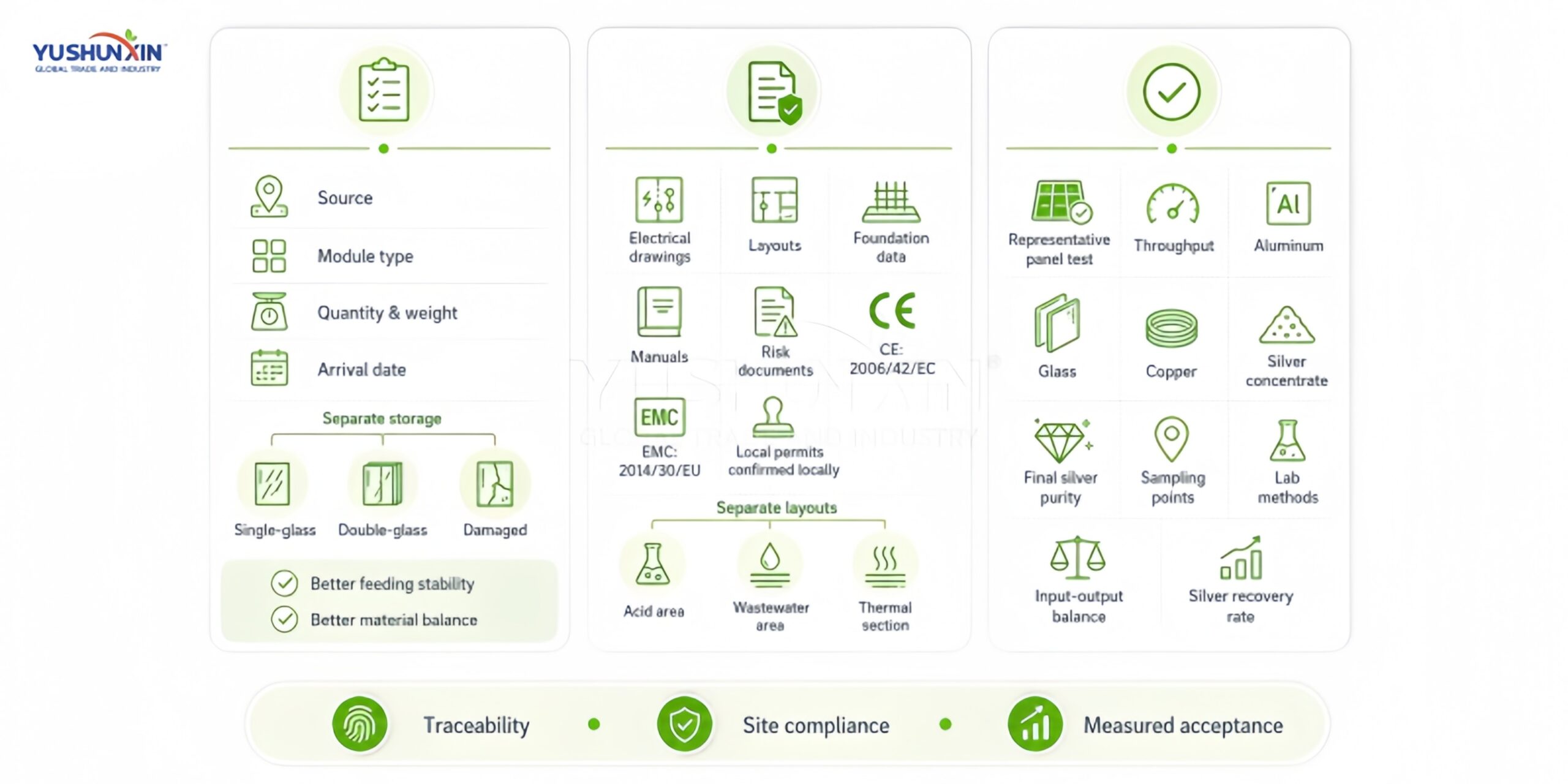
The buyer needed clear records for every incoming batch. These records included source, module type, quantity, weight, and arrival date. Single-glass, double-glass, and damaged panels also required separate storage. This approach improved feeding stability and later material-balance calculations.
Site Documents Supported Local Compliance
Yushunxin prepared electrical drawings, layouts, foundation data, manuals, and risk documents. The CE certificate references 2006/42/EC and 2014/30/EU requirements. However, local specialists still needed to confirm final permits. The acid area, wastewater area, and thermal section also required separate layouts.
Material Balance Proved Recovery Performance
Acceptance testing needed representative solar panels, not an empty machine run. The test recorded throughput, aluminum, glass, copper, silver concentrate, and final silver purity. Both parties also defined sampling points and laboratory methods. Finally, the complete input-output balance confirmed the actual silver recovery rate.
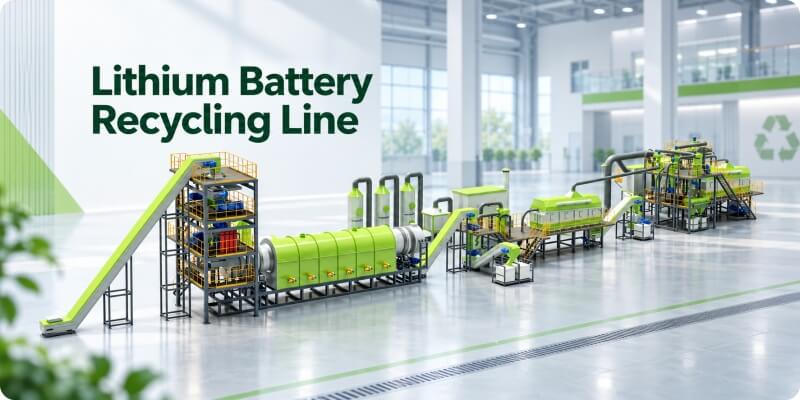
Get your Solution!The above describes our communication with the French customer about a solar panel silver recovery project. In addition, Yushunxin also provides other PV recycling solutions, such as solar panel pyrolysis lines, mechanical PV separation systems, and complete PV silver extraction and refining lines. If you need another e-waste recycling plan, we can design lithium battery recycling lines and e-waste pyrolysis systems. Send us your module type, annual volume, target products, and local requirements for a suitable configuration.
”
From Your Needs
to Real Impact


