

















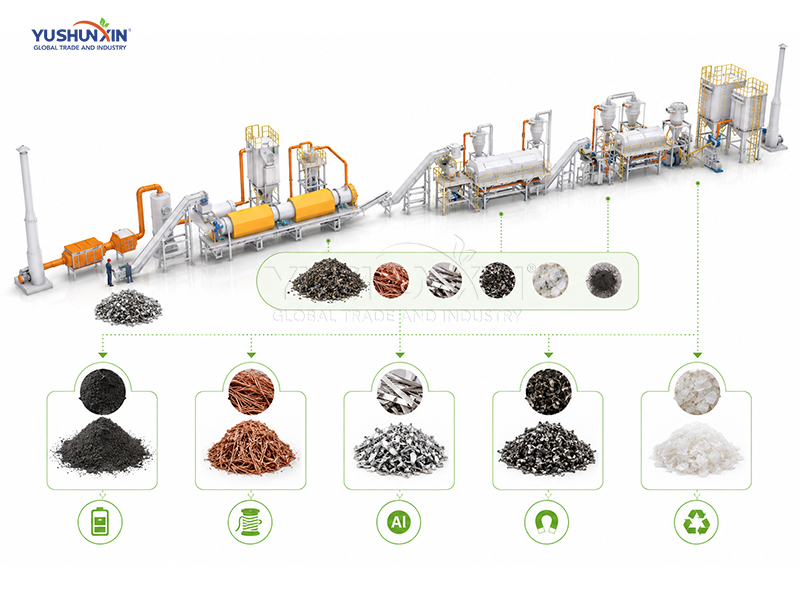

Black mass is becoming a central output in industrial lithium battery recycling. Buyers now focus on powder purity, copper and aluminum removal, and safe material handling. Therefore, discharge, crushing, screening, and collection must work as one system. This shift is changing equipment selection, plant layout, and project acceptance standards.
How Are Black Mass Markets Reshaping Lithium Battery Recycling Lines?
Black mass is moving from a secondary output to the main commercial target. This shift changes how recyclers judge crushing, separation, and product handling. Buyers now compare saleable powder quality, not only recovery weight. Therefore, plant design increasingly starts with downstream material specifications.
Buyers Are Moving Beyond Black Mass Recovery Rates
Mixed powder can contain copper, aluminum, iron, plastics, electrolyte residues, and excess dust. These impurities can reduce buyer acceptance and complicate hydrometallurgical processing. Therefore, a high recovery rate does not guarantee a high-value product. Industrial buyers also assess purity, moisture, particle size, volatile content, and packaging stability. A complete line must separate black mass, copper, aluminum, iron, and plastics consistently. The Yushunxin process treats these outputs as separate recovery products.
| Quality Factor | Commercial Effect |
| Black mass purity | Influences buyer acceptance and treatment costs |
| Copper and aluminum carryover | Increases impurity levels and reduces product value |
| Moisture and volatile content | Affects storage, transport, and downstream preparation |
| Particle size | Influences sampling consistency and leaching performance |
| Packaging stability | Supports safer handling and batch traceability |
NMC and LFP Are Creating Different Product Markets
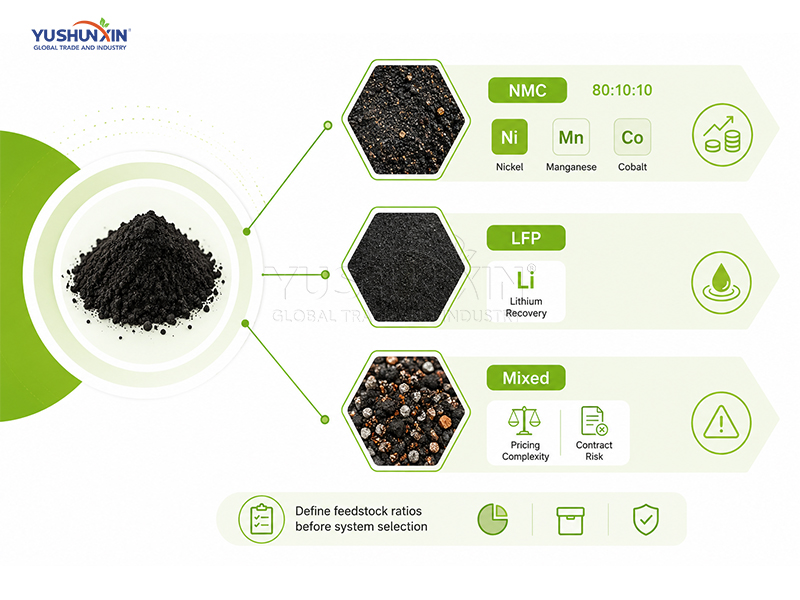
NMC and LFP black mass cannot follow one commercial model. NMC811 uses an 80:10:10 nickel, manganese, and cobalt ratio. Therefore, nickel-rich material supports different recovery and pricing routes. LFP routes focus more on lithium recovery and processing volume. Meanwhile, mixed chemistry can weaken pricing clarity and complicate downstream contracts. Projects should define feedstock ratios before selecting separation and storage systems.
| Project Factor | NMC Black Mass | LFP Black Mass |
| Main recovery focus | Nickel, cobalt, manganese, and lithium | Lithium and phosphate-bearing materials |
| Downstream route | Critical-metal recovery | LFP-focused hydrometallurgy |
| Main quality risk | Copper, aluminum, and chemistry dilution | Lithium loss and mixed-feed contamination |
| Plant priority | Impurity control and chemistry separation | Stable throughput and lithium recovery |
Separate production campaigns can preserve chemistry control and reduce cross-contamination. Batch codes and retained samples can also strengthen buyer traceability. Moreover, wet hydrometallurgy should remain a distinct downstream processing stage.
Why Is Black Mass Quality Moving Upstream?
Black mass quality now starts before the first crusher. Industrial buyers increasingly review discharge, feeding, crushing, and separation as one connected system. Poor upstream control raises copper, aluminum, plastic, and electrolyte contamination. Therefore, plant design is shifting upstream, where feedstock data can still prevent product losses.
Feedstock Data Drives Discharge Selection
Feedstock Data determines Discharge Selection. Battery format, SOC, chemistry and shell structure define discharge, feeding and crushing requirements.
Closed Crushing Improves Process Stability
Closed Crushing reduces dust, vapor and heat risks. Sealed feeding, negative pressure and monitoring systems protect black mass quality during processing.
Separation Performance Depends On Line Balance
Separation Performance requires balanced screening, airflow, magnetic and metal separation. Testing confirms black mass purity, metal recovery and continuous operation stability.
How Are Buyers Verifying Black Mass Recovery Performance?
Industrial buyers now expect production evidence, not nominal capacity. They compare powder purity, metal loss, operating stability, and actual output. Therefore, acceptance trials must use real batteries and measurable product results.
Real Feedstock Trials Replace Empty-Load Testing
Empty-load testing only proves that the equipment can run. It does not confirm black mass recovery under real conditions. Trials should reflect battery chemistry, cell format, remaining charge, and casing material. Teams should record throughput, black mass output, purity, copper-aluminum carryover, and continuous operating time.
Capacity Must Match Real Operating Conditions
Rated capacity should match battery type, pretreatment level, screen load, power supply, and cleaning frequency. Buyers should measure sustained production instead of short test runs. The project should also define black mass packaging, sampling, storage, and wet-process transfer. Mechanical recovery and hydrometallurgy remain separate systems, but their interface requires early confirmation.
Mass Balance Reveals Hidden Recovery Losses
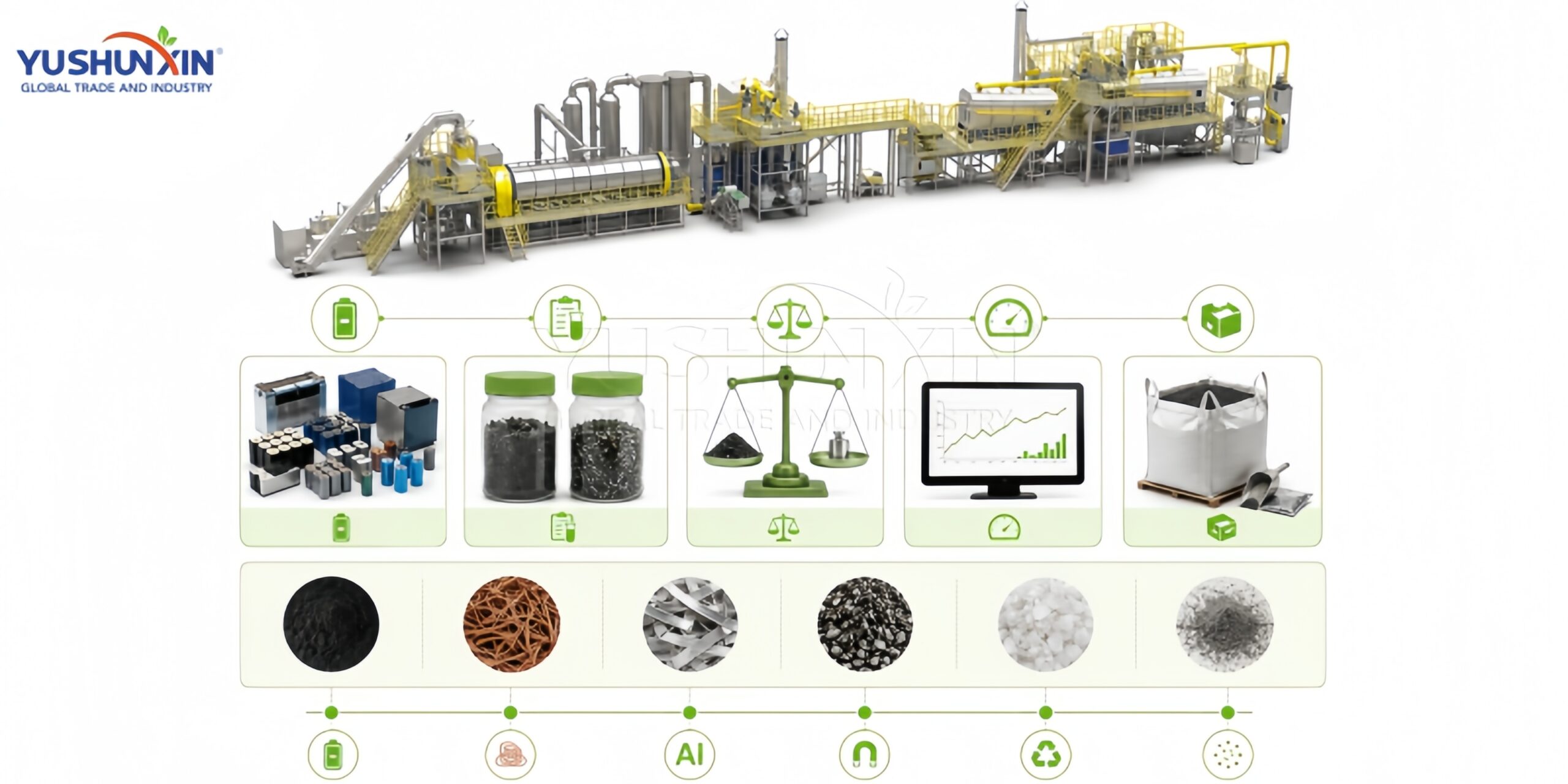
A high recovery rate does not always mean high-quality black mass. Excessive crushing may increase metal contamination. This data shows whether valuable powder remains attached to metal fractions.
Get your Solution!| Output | Key Acceptance Data |
| Black mass | Weight, purity, particle size, moisture |
| Copper and aluminum | Recovery weight and black mass loss |
| Plastics and iron | Separation efficiency and residual content |
| Unseparated material | Weight and recirculation ratio |
Black mass recovery now affects feedstock control, safe crushing, separation accuracy, and final product value. Therefore, buyers should evaluate the entire production line, not one crusher or screen. Yushunxin can develop a complete solution around battery type, capacity, purity targets, site layout, and downstream requirements. And if you need other solutions, such as lithium battery recycling plant, lithium battery crushing and sorting line and black mass recovery for lithium battery disposal.
”
From Your Needs
to Real Impact


