

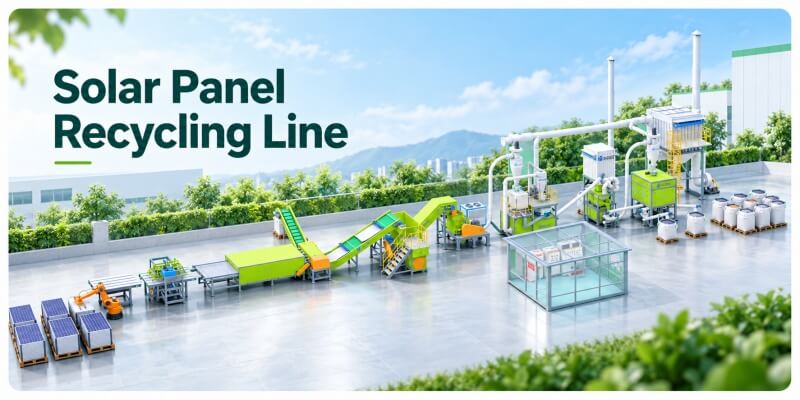




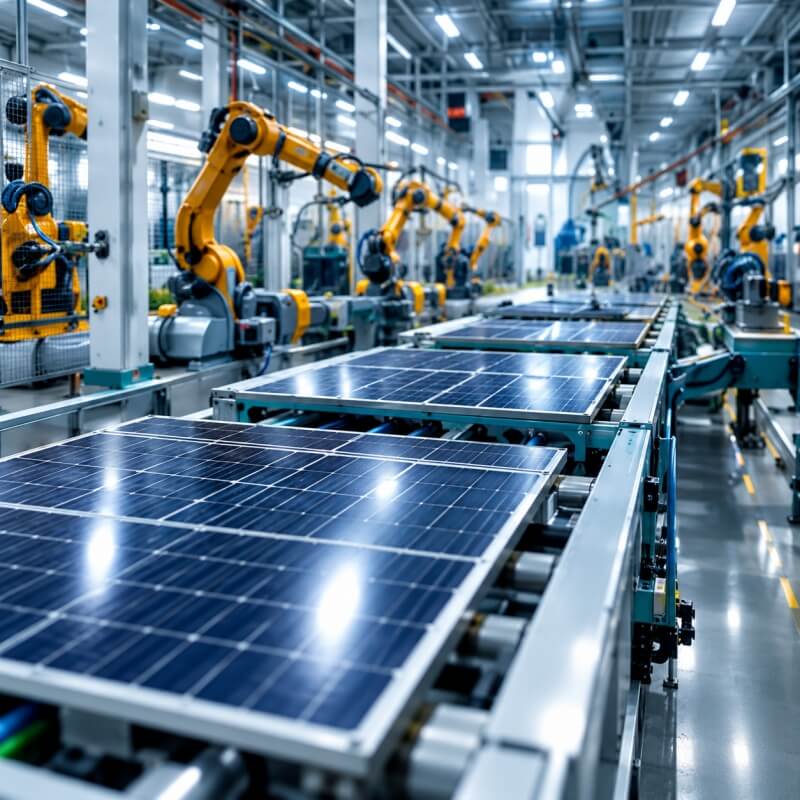








Mechanical recycling and pyrolysis recycling produce different recovery results from retired solar panels. Therefore, buyers should not choose a process by equipment price alone. Mechanical recycling usually suits uniform single-glass modules and controlled glass separation. Pyrolysis better handles mixed panels, damaged modules, and strong EVA or POE bonding. This FAQ explains how feedstock, product targets, capacity, and site conditions shape the decision.
How Should Module Structure Shape the Recycling Solution?
Module structure should define the first recycling route. Single-glass panels usually allow more controlled glass removal. Double-glass and damaged modules create stronger separation challenges. Therefore, buyers should classify feedstock before comparing complete-line quotations.
Choose Mechanical Separation for Uniform Single-Glass Feedstock
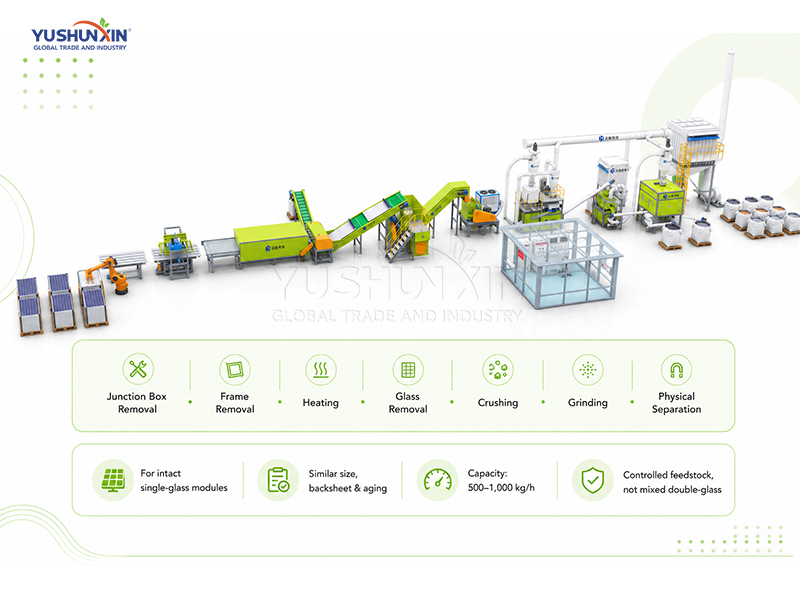
Mechanical PV recycling suits projects dominated by intact single-glass crystalline modules. The panels should have similar dimensions, backsheet structures, and aging conditions. First, the line removes junction boxes and aluminum frames. Then, controlled heating softens EVA before mechanical glass removal. Remaining laminates enter crushing, grinding, and physical separation. Standard industrial lines can process about 500-1,000 kg/h. However, large double-glass volumes can disrupt stable delamination. Mechanical processing therefore needs controlled feedstock, not mixed module loading.
Select Thermal Delamination for Mixed or Strongly Bonded Modules
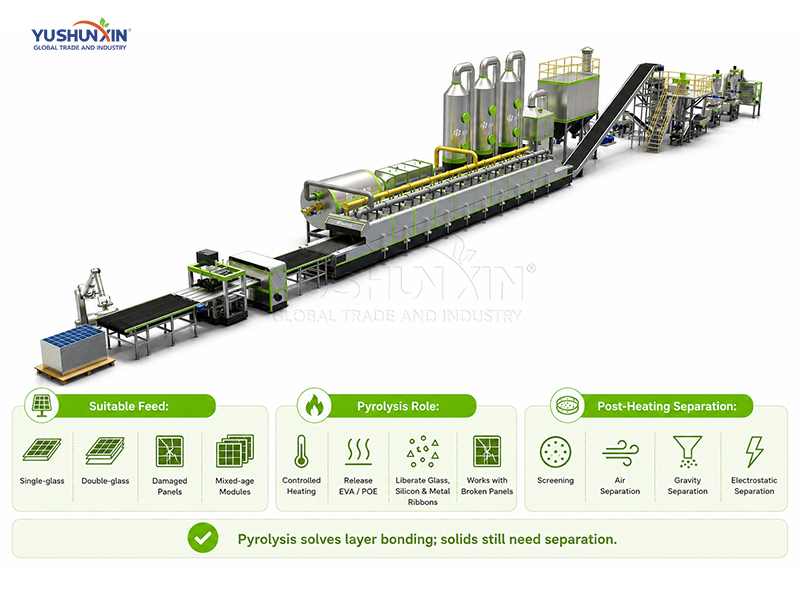
PV pyrolysis suits projects handling single-glass, double-glass, damaged, and mixed-age modules. It works when EVA or POE resists stable mechanical removal. Controlled heating decomposes the encapsulant and releases glass, silicon, and metal ribbons. This route also accepts broken panels that cannot enter glass-removal equipment consistently. However, pyrolysis only solves layer bonding. After heating, solids still require screening, air separation, gravity separation, or electrostatic separation.
| Feedstock Condition | Recommended Solution | Main Reason |
| Uniform single-glass panels | Mechanical recycling | Supports controlled glass removal |
| Mixed single-glass and double-glass panels | Pyrolysis recycling | Handles different bonding structures |
| Heavily broken modules | Pyrolysis recycling | Avoids unstable mechanical delamination |
| Strong EVA or POE bonding | Pyrolysis recycling | Releases bonded material layers |
| Consistent intact modules | Mechanical recycling | Maintains stable hourly processing |
Classify the module structure before selecting equipment. Uniform single-glass feedstock can support mechanical separation. Mixed or strongly bonded modules usually need thermal delamination.
How Do Product Specifications Define the Recycling System?
Your recycling route should start with confirmed product specifications. Glass buyers, silicon processors, metal refiners, and silver plants accept different material grades. Therefore, project design must target saleable purity, particle size, and material concentration. Recovery percentages matter only when each output meets a clear downstream requirement.
Release High-Value Fractions
Through Thermal Delamination
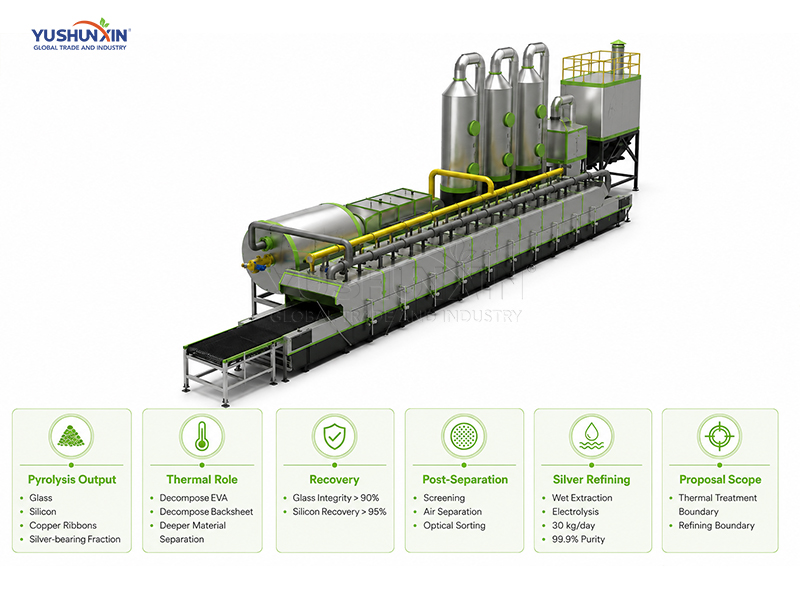
Pyrolysis suits projects that require deeper separation across several material products. Controlled heat decomposes EVA and backsheet polymers. Therefore, glass, silicon, copper ribbons, and silver-bearing fractions separate more effectively. Under suitable conditions, glass integrity retention can exceed 90%. Meanwhile, silicon wafer recovery can exceed 95%. Screening, air separation, and optical sorting then improve each recovered fraction. Silver-bearing material can also enter wet extraction and electrolysis. One refining configuration produces 30 kilograms of silver daily at 99.9% purity. Therefore, the proposal must define both thermal treatment and downstream refining boundaries.
Preserve Glass Value Through
Controlled Mechanical Delamination
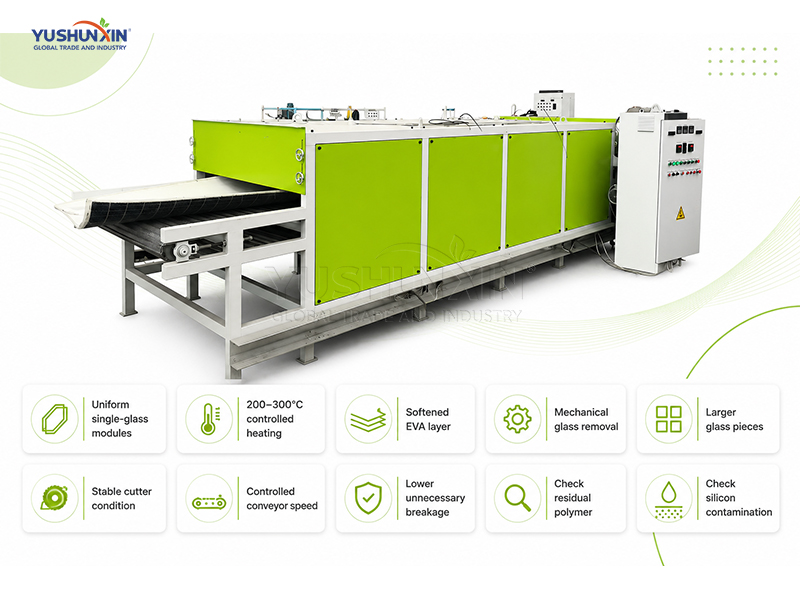
Mechanical processing suits projects that prioritize larger glass pieces from uniform single-glass modules. Controlled heating softens the EVA layer before the removal system separates the glass. Some systems use 200-300°C heating before mechanical glass removal. Stable temperature, cutter condition, and conveyor speed reduce unnecessary breakage. However, excessive crushing mixes glass with silicon and lowers product value. Therefore, buyers should confirm particle size, residual polymer, and silicon contamination before selecting equipment.
Choose the system around the product your buyers will purchase. Mechanical delamination can protect glass value when feedstock remains uniform. Pyrolysis creates stronger liberation when projects target several high-value fractions. Yushunxin can combine material testing, separation design, and silver-refining interfaces within one project proposal. High recovery rates have limited value when product purity remains unstable.
How Can the Project Turn Rated Capacity Into Stable Daily Output?
Rated capacity alone cannot predict annual output. Actual production depends on feeding, operating hours, maintenance, and product discharge. Therefore, buyers should compare both routes under the same operating assumptions.
Project Decision
Mechanical and pyrolysis lines use different production models. Therefore, buyers should compare stable annual output, rather than one rated capacity. This comparison gives a clearer basis for equipment selection and future expansion.
Coordinate Every Mechanical Stage Around One Hourly Flow
Plan Pyrolysis Capacity Around Complete Thermal Cycles
Convert Both Routes Into Annual Operating Output
Mechanical recycling suits uniform single-glass modules and projects that prioritize stable glass recovery. Pyrolysis suits mixed modules, strong EVA bonding, and deeper material liberation. Yushunxin can test your panels and configure a complete mechanical or pyrolysis recycling solution. We can also integrate separation, silver recovery, utilities, and compliance into one project plan. For line selection, we can help you configure solar panel recycling production line.
”
From Your Needs
to Real Impact


