











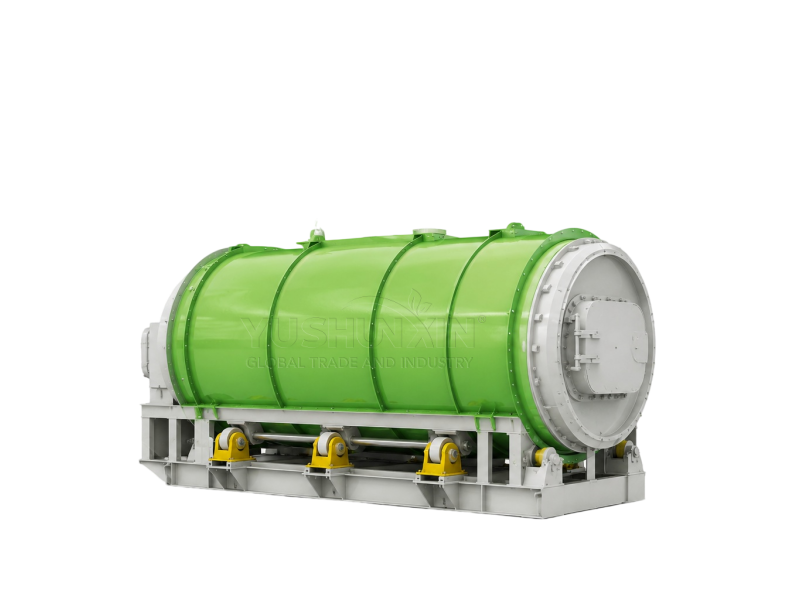


Yushunxin’s rotary pyrolysis reactor for solar panel recycling supports stable industrial treatment of retired PV modules. It removes EVA, backsheets, and organic layers before downstream material separation. Available configurations process approximately 6-15 tons per batch. We customize reactor size, alimentation, carburant, refroidissement, manipulation de gaz, and automation around your panel type, capacité requise, and local environmental standards.
How Can the Reactor Create Separation-Ready PV Outputs?
01 · OutputsIndustrial PV recyclers need controlled outputs, not only heated material. The reactor must release laminated layers while protecting recoverable glass, silicium, cuivre, et fractions argentifères. Donc, Yushunxin designs each reactor around module structure, état d'alimentation, and downstream separation requirements.
Match Feed Preparation to Each Module Structure
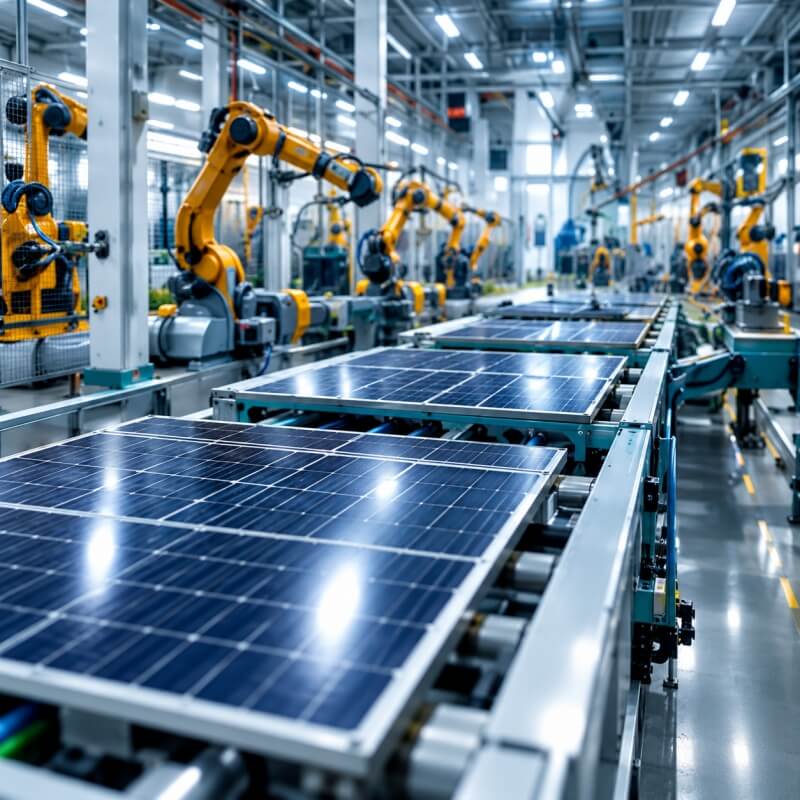
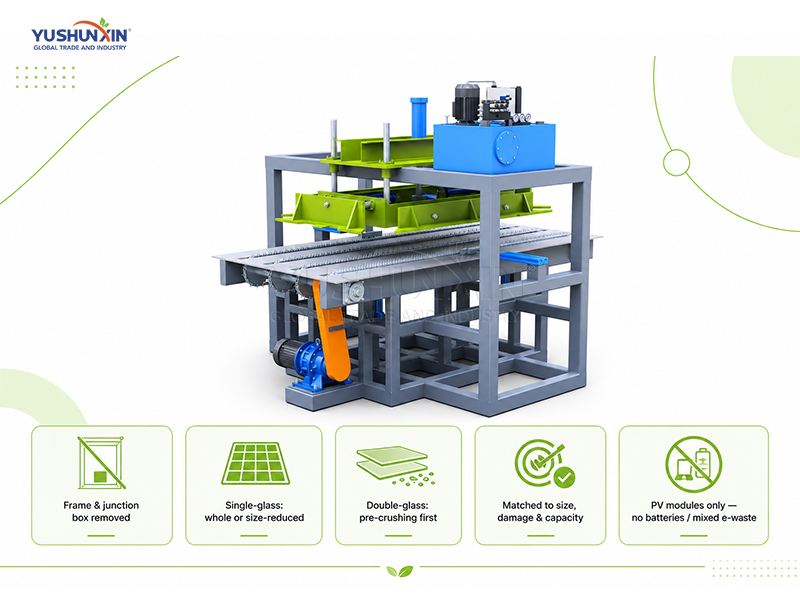
Single-glass and double-glass modules require different feeding routes. Operators first retirer les cadres en aluminium et les boîtes de jonction. Single-glass modules can enter whole or after controlled size reduction. Cependant, double-glass modules usually need pre-crushing. This step improves loading density and heat transfer. Yushunxin matches the loading system to panel size, niveau de dégâts, et capacité requise. The reactor processes prepared PV modules rather than mixed electronic waste. Donc, batteries, heavy metal blocks, and unidentified waste must remain outside the feed stream.
Controlled Pyrolysis Releases the Laminated Layers
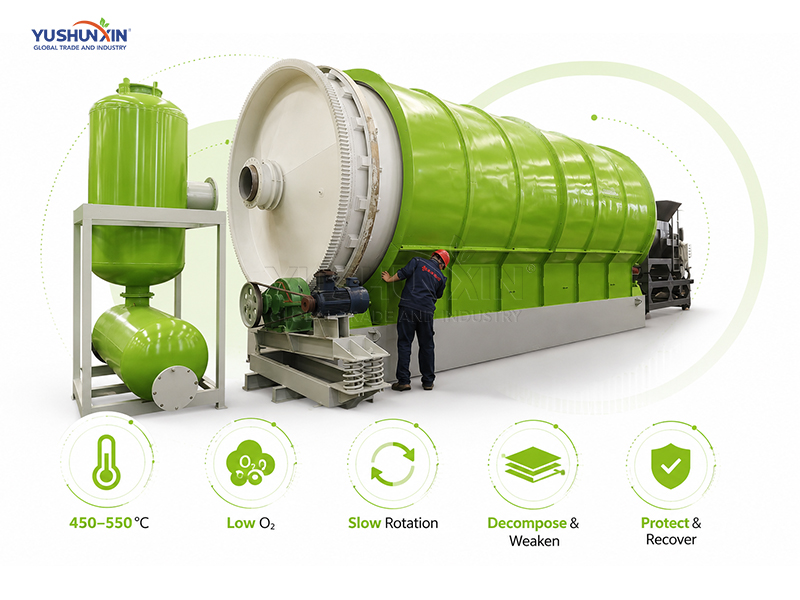
Yushunxin controls the main thermal zone around 450-550°C. Cependant, the exact setting depends on EVA, POE, and backsheet composition. Low-oxygen conditions limit oxidation of glass, silicium, and metals. Entre-temps, slow rotation improves material contact and heat exposure. The process decomposes organic encapsulation layers and weakens interlayer bonding. It does not melt the valuable inorganic materials. Donc, operators can protect recoverable fractions while achieving stable delamination.
Deliver Separable Outputs to the Recovery Line
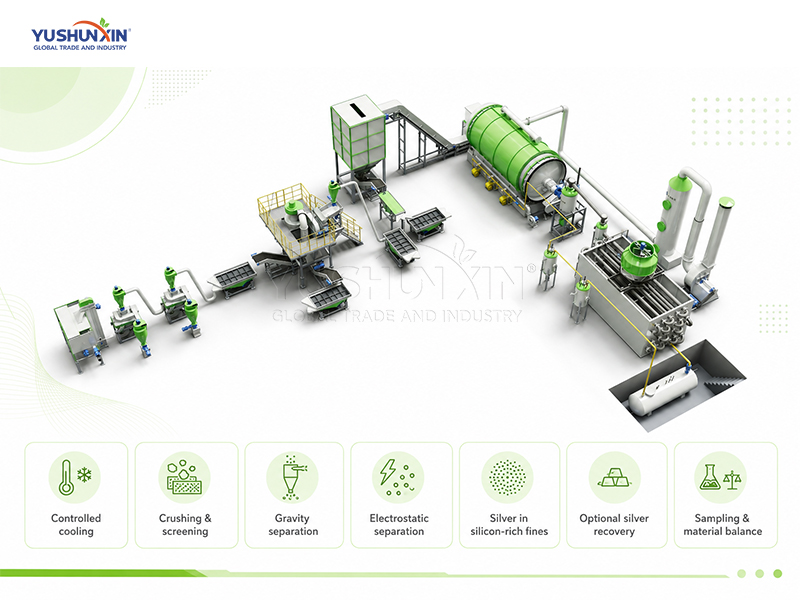
Après pyrolyse, verre, cellules de silicium, rubans de cuivre, and metal layers separate more easily. The discharge then enters controlled cooling. Suivant, crushing and screening prepare each material for further recovery. Séparation par gravité concentrates materials with different densities. Electrostatic separation then improves metal and non-metal separation. Entre-temps, silver remains mainly within silicon-rich fines or concentrated powder. An optional silver recovery section can increase total project value. Yushunxin verifies discharge quality through sampling, trial processing, and material balance analysis. The complete route connects thermal treatment with cooling, dépistage, séparation gravitaire, et séparation électrostatique. The reactor does not complete recovery alone. Plutôt, it creates a controlled material structure for the next separation stage.
How Does Structural Engineering Keep the Reactor Stable Across Repeated Batches?
02 · StableIndustrial PV projects require more than a large reactor chamber. Shell strength, rotation accuracy, scellage, insulation, and monitoring must work together. Donc, Yushunxin designs each reactor as an integrated thermal system. This structure supports stable heating, controlled pressure, predictable discharge, and easier maintenance.
Controlled Rotation Protects Heat Transfer
Controlled Rotation maintains material movement and heat distribution. Variable-frequency drive and overload protection improve EVA decomposition and mechanical reliability.
Sealing, Pressure Control And Refractory Protection
Sealing and Pressure Control reduce air entry and stabilize gas flow. Refractory Protection limits heat loss and supports long-term reactor operation.
Q345R Shell Design Resists Thermal Loading
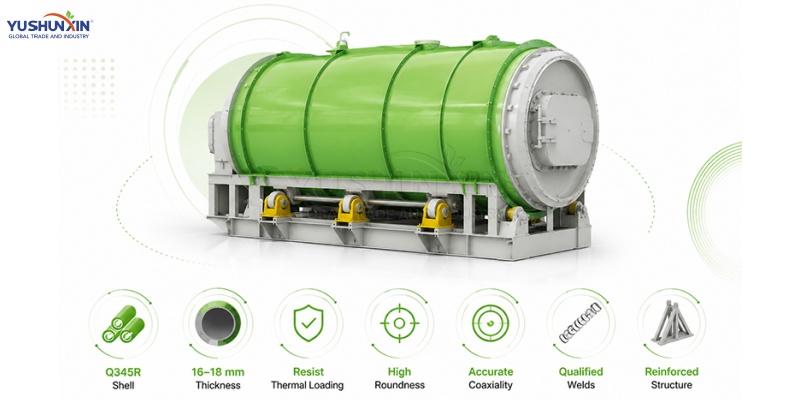
Q345R Shell Design with 16–18 mm thickness reduces deformation during heating cycles. Accurate alignment, welding and reinforcement improve reactor stability and service life.
Obtenez votre solution!Which Reactor Configuration Supports Your Planned Output?
03 · ConfigurationReactor selection should start with real panel data and planned operating hours. A larger vessel only adds value when loading, chauffage, refroidissement, and discharge remain balanced. Donc, Yushunxin compares panel weight, module structure, bulk density, shift schedules, and local utilities before confirming capacity.
Choose Reactor Size Around Real Feedstock Data
These values provide planning references, not fixed production guarantees. A 15-ton batch can hold about 750 single-glass panels at 20 kg each. It can also hold roughly 470 double-glass panels at 32 kg each. Broken modules may increase loading density, but they require different feeding arrangements. Donc, Yushunxin confirms final capacity through feedstock samples, photographs, dimensions, and loading tests.
Calculate Capacity From the Complete Batch Cycle
A 15-ton batch does not guarantee 15 tons per calendar day. Daily output depends on loading speed, heating time, cooling method, discharge design, and shift coverage. The full cycle includes preparation, chargement, pyrolyse, gas generation, refroidissement, décharge, inspection, and restart. A water-cooled rear discharge system can save about 1.5-2 heures par lot. It also allows cleaner discharge at around 70-80°C. Donc, project planning should compare daily, monthly, and annual output.
Match Fuel and Power With the Site
Natural gas, GPL, and diesel can support stable start-up heating. After gas production stabilizes, suitable pyrolysis gas can return to the burner. Fuel demand still changes with ambient temperature, insulation quality, material condition, and fuel heat value. Pour référence, a 15-ton configuration may use about 449 kg of diesel equivalent before gas reuse. Donc, buyers should provide fuel prices, supply pressure, tension, frequency, limites d'émission, and available plant space. Yushunxin then matches burners, fans, controls, and electrical systems to the final site conditions.
| Typical Reactor Size | Shell Thickness | Reference Capacity | Application appropriée |
| Ø2.2 × 6.6 m | Project-based | À propos 6 tons/batch | Pilot-industrial or regional plants |
| Ø2.6 × 6.6 m | À propos 16 mm | À propos 10 tons/batch | Medium industrial recycling plants |
| Ø2.8 × 6.6 m | À propos 18 mm | À propos 15 tons/batch | Centralized PV recycling projects |
| Ø2.8 × 8 m | À propos 18 mm | Feedstock-dependent | Customized high-volume projects |
How Can Yushunxin Build a Turnkey PV Recycling Line Around the Rotary Reactor?
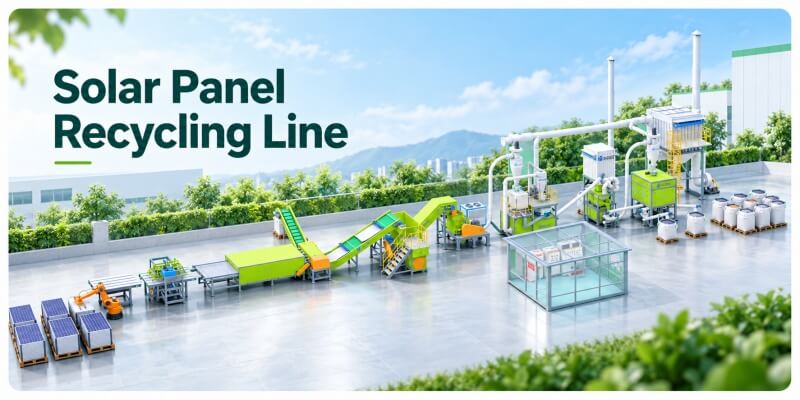
04 · YushunxinA rotary reactor only completes the thermal separation stage. A profitable plant must connect feeding, contrôle du gaz, refroidissement, séparation, and material upgrading. Yushunxin matches these units around panel structure, daily capacity, cibles de produits, and local regulations. This integrated design reduces transfer losses and keeps every downstream unit correctly loaded.
Pretreatment Sets Loading
Density And Cycle
Pretreatment removes junction boxes and frames before thermal treatment. Whole-panel or pre-crushing routes affect loading density, heating efficiency and reactor cycle stability.
Gas Route Controls
Pressure And Energy Reuse
Gas Route manages pyrolysis gas through sealing, negative pressure and cleaning systems. Gas reuse reduces fuel demand while safety devices control pressure and flashback risks.
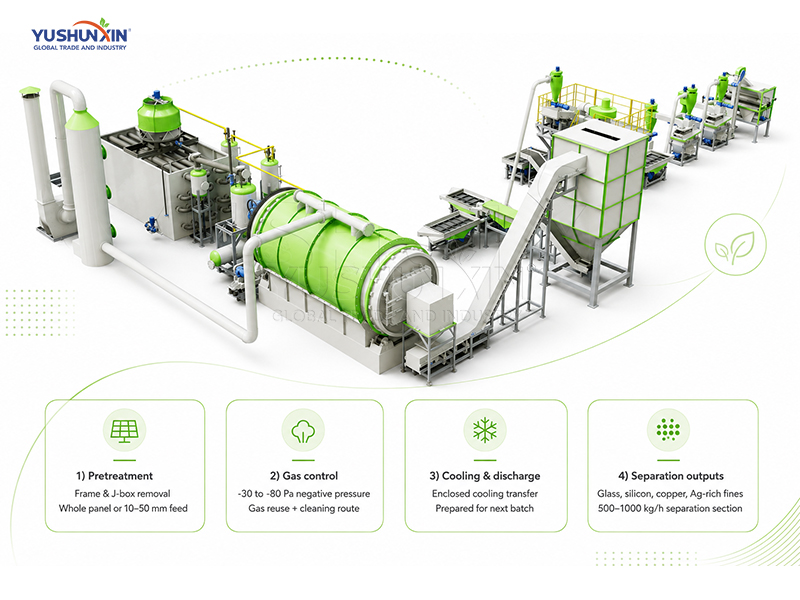
Cooling And Discharge
Protect Next Cycle
Cooling and Discharge reduce material temperature before transfer. Controlled cooling, enclosed discharge and conveyors improve safety and prepare stable feeding for the next cycle.
Separation Line Creates
Fractions vendables
Separation Line converts treated material into glass, silicium, copper and silver-bearing products. Dépistage, gravity and electrostatic separation improve purity and recovery value.
Résumé
A rotary pyrolysis reactor supports controlled EVA decomposition, stable batch operation, and flexible capacity for industrial PV recycling projects. Yushunxin can design a complete turnkey solution around your panel structure, capacité, approvisionnement en carburant, disposition du site, and product goals. Our scope can include pretreatment, manipulation de gaz, refroidissement, séparation physique, contrôle de la poussière, and silver recovery. We can also provide you with other solutions: single-glass solar panel recycling plant and double-glass solar panel pyrolysis process. Ensemble, these solutions help you compare technical routes and confirm the right project configuration.
De vos besoins
à un impact réel


